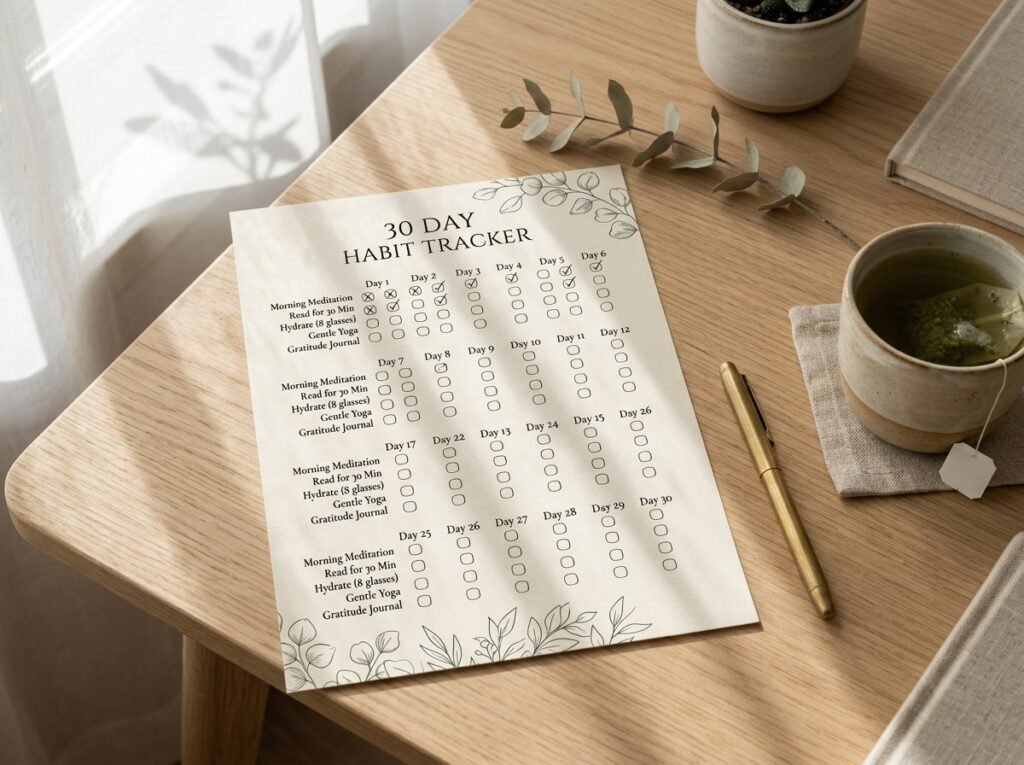
To start a habit tracker you will actually keep, choose one small habit, shrink it to under two minutes, and tick it on a paper grid each day. The approach in this guide is to keep the bar low and use the “Never Miss Twice” rule, so one missed day does not break the pattern. Research from University College London (Lally et al., 2010), already cited in this article, found that habits took an average of 66 days, and anywhere from 18 to 254 days, to become automatic.
By day five, life happens. A late train, a stressful afternoon at work, or an unexpected headache intrudes. You miss one day. The clean grid is broken. Disappointment creeps in, and within a fortnight, the entire tracker has been pushed to the bottom of a drawer.
This familiar cycle isn’t a failure of willpower or discipline. It is a design flaw in how we approach habit formation. Here is how to create a calm habit-tracking rhythm that you will look forward to opening every single day.
1. Lower the bar until it feels almost ridiculously easy
When starting a new habit, the goal during your first thirty days is not performance — it is establishing identity and presence. If your intention is to begin daily movement, committing to a forty-minute intense workout introduces enormous cognitive friction on tiring days.
Instead, shrink the daily requirement down to something that takes under two minutes. Two gentle stretches beside your bed. Two pages of a book before switching off the light. One glass of room-temperature water as the kettle boils.
“A habit must be established before it can be improved. You cannot optimise a rhythm that doesn’t yet exist.”
When the threshold is so gentle that you can accomplish it even when exhausted, you protect your chain of ticks. That quiet consistency transforms self-perception: you become someone who shows up for yourself every single day.
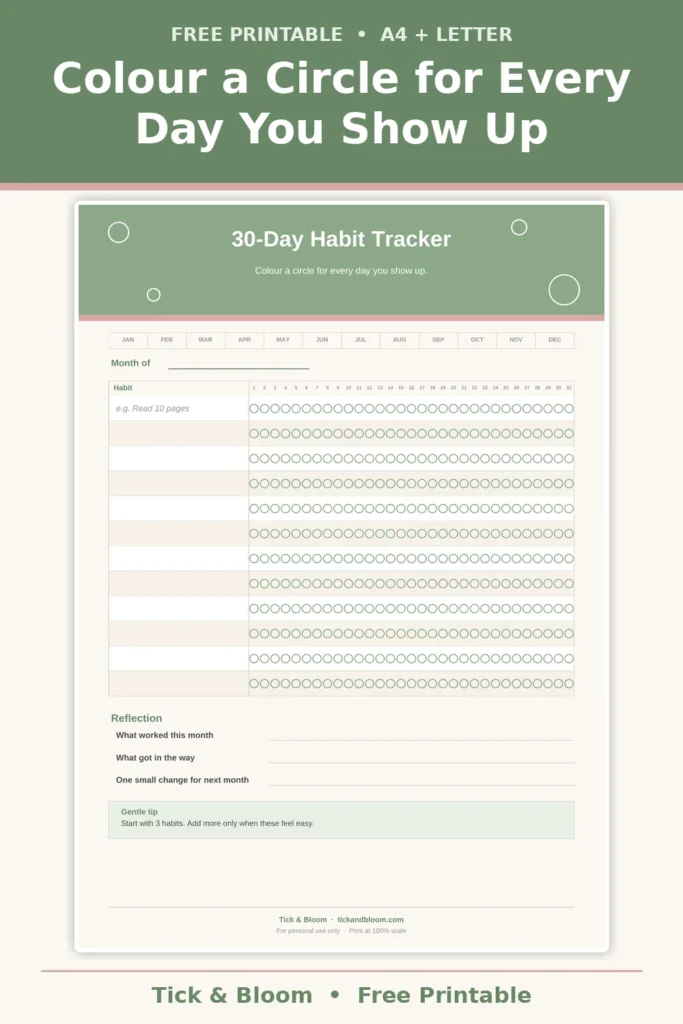
2. Why paper beats smartphone apps every time
Digital habit apps promise convenience with automated push reminders and cloud sync. Yet research continually reveals that unlocking your mobile phone exposes your brain to a minefield of distractions: unread notifications, email alerts, social media feeds, and blue-light stimulation.
A paper tracker offers a singular, tactile sanctuary. There are no battery warnings, no premium monthly subscriptions, and no intrusive red badges. The physical act of holding a favourite pen and marking a neat tick creates a tangible dopamine feedback loop that a phone screen simply cannot replicate.
3. Follow the “Never Miss Twice” guideline
Perfectionism is the greatest enemy of sustainable habits. Life will inevitably interrupt your plans, and expecting thirty unbroken days every month creates unnecessary tension.
Adopt a kinder philosophy: missing one day is an accident; missing two days in a row is the start of a different pattern. If a migraine or travel prevents you from ticking your reading circle on Tuesday, do not despair. Simply mark a gentle dot and make a gentle promise to take three quiet breaths on Wednesday.
4. Use monthly reflection to adjust your sails
At the end of thirty days, do not simply discard your page. Spend five minutes examining where your ticks clustered and where blank spaces appeared.
- Which habits flowed naturally without effort? These are now becoming second nature. You can keep ticking them or graduate them to background routines.
- Which habits met constant friction? Ask yourself honestly: was the habit too demanding, or was the timing inconvenient? Adjust the time of day or shrink the scope for the coming month.
If you would rather have the month laid out for you, our free monthly habit tracker printable gives you the same grid with space for a short note at the end of the month.
Habit building is not a test with a pass or fail grade. It is an ongoing conversation with your lifestyle and your energy. Take gentle steps, honour your current season of life, and allow yourself to bloom at your own peaceful pace.
If mornings are where your best intentions live, our guide to designing a calm 10-minute morning routine pairs beautifully with your new tracker.
The same gentle approach also works in other lives: a habit tracker for students, a habit tracker for couples, a morning routine checklist for teens, a habit tracker for kids, and a morning routine checklist for kids printable.
If keeping any routine has always felt harder for you than it seems to for others, read our habit tracker for ADHD guide. It uses the same free grid with fewer rows and more forgiving rules.
5. When the tracker is working, pick a challenge
Once the daily grid feels easy — a few weeks of steady ticks and the two-minute version no longer takes any effort — a challenge with a finish line can keep the habit interesting without raising the daily bar. The grid stays the same; only the frame around it changes. Pick one of these, and keep ticking the same way:
- The 75 Soft Challenge is the gentle version: a 75-day challenge with lighter daily rules and a free printable tracker.
- The 75 Medium Challenge is the steadier version: firmer rules than Soft, still built around the same daily tick.
- 66-Day Habit Challenge builds one habit over 66 days, using the same University College London research cited above as its guide.
- Not sure which 75-day version fits you? Our 75 Soft vs 75 Medium comparison guide walks through the differences side by side.
- If you are a student, pair the tracker with a daily planner printable for students so the day’s plan and the habit grid sit together.
Frequently asked questions
How long does it actually take to build a daily habit?
Research from University College London (Lally et al., 2010) found that habits take an average of 66 days (and anywhere from 18 to 254 days) to become automatic, which is why undated monthly paper grids work better than rigid 21-day challenges.
What is the ‘Never Miss Twice’ rule in habit tracking?
Missing a single day has virtually zero impact on long-term habit formation, provided you resume the smallest two-minute version of your habit the very next day.
Why use a paper habit tracker instead of a mobile app?
Paper trackers eliminate smartphone push notifications, subscription paywalls, and social media distractions while providing a visible physical cue on your desk or fridge.
Ready to start small?
Pick one habit that matters to you today. Download your tracker, print it out, and take your very first step.