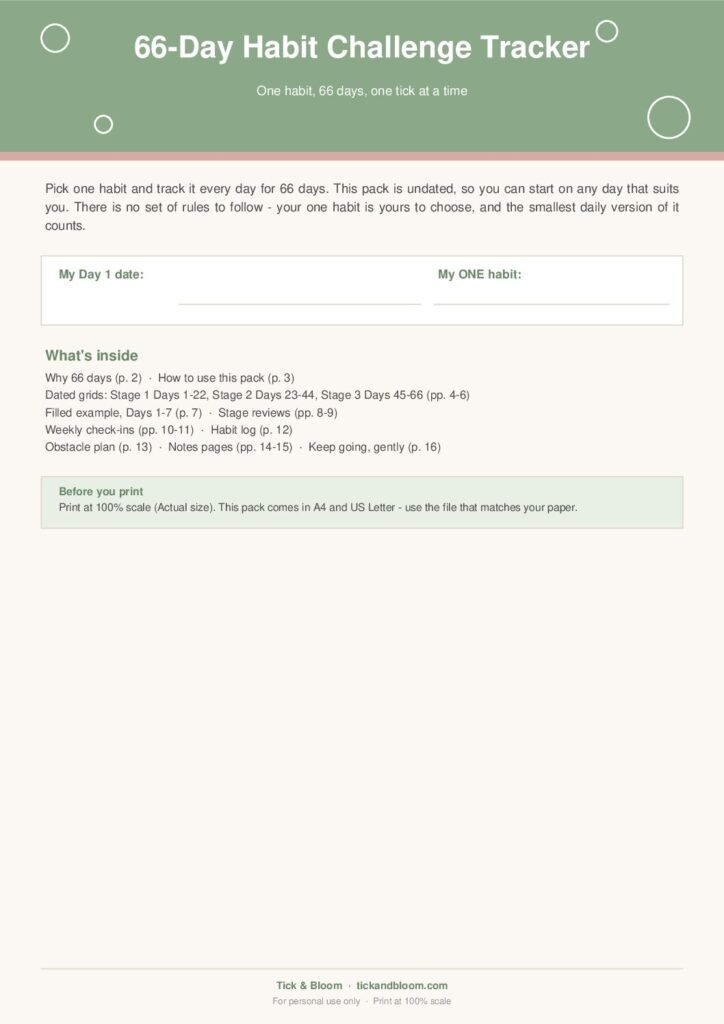
The 66-day habit challenge is simple: pick ONE habit, do it every day for 66 days, and tick it off on a paper tracker. It suits anyone who wants to work on a single habit properly, instead of juggling a whole list of new rules at once — and 66 days is a median from one study (Lally et al., 2010), not a promise: that study reported a median of 66 days for a new behaviour to feel automatic, with a very wide range, from 18 to 254 days.
That last sentence matters more than the number. The challenge is not “do this for 66 days and your habit is formed”. It is “give one habit 66 days of daily attention, and see what actually happens”. This guide explains the challenge as it is — one habit, three 22-day stages, a keep-going rule for missed days — and pairs it with a free 16-page printable tracker so you can record all 66 days on paper. Nothing here promises an outcome: 66 days is a length of time for a challenge, not a promise about what changes in that time.
What 66 days means — and what it does not
The number 66 comes from one study that followed people forming a new daily behaviour and measured how long it took before the behaviour started to feel automatic. The median was 66 days. A median is a middle value, not an average and not a deadline: half the people in that study took longer than 66 days, and the full range ran from 18 days to 254 days. Some habits in the study were simple (drinking a glass of water with lunch); others were harder (fifty sit-ups after morning coffee). The simpler the habit, the faster it tended to settle — which is exactly why this challenge asks you to pick the smallest daily version of your habit, not the most impressive one.
So 66 days is a reasonable length for a challenge: long enough that a daily habit gets a fair test, short enough to plan around, and honest about its own limits. If your habit still needs effort on Day 66, that is not a failure of the challenge — it is information. The pack’s Day 66 reflection page is built for exactly that moment: which parts stuck, what to keep doing, and what comes next.
Pick your ONE habit before Day 1
This challenge has no fixed rule set. There is no water target, no reading target, no workout rule — those belong to the 75-day challenge family, not this one. Here you choose a single habit before Day 1, and that habit is the whole challenge. Choosing it well is the single most useful step in this guide, so do it on paper before you start:
- Name the habit in one sentence. “Walk for 15 minutes after lunch” beats “get fitter”. “Read two pages before bed” beats “read more”. If you cannot write it in one sentence, it is probably two habits — pick one.
- Write down why it matters, in your own words. Not a slogan — the actual reason. “I want a walk that is mine, not squeezed in after everything else” will carry you further on a tired day than “I should exercise”.
- Shrink it to its smallest daily version. The version you can do on your worst day, not your best one. A 15-minute walk shrinks to a 5-minute walk around the block; ten pages shrink to two. The smallest version is the real habit — the bigger version is a bonus for good days.
- Settle when and where it happens. “After lunch, out the front door” is a plan. “Sometime today” is a hope. Write the time and place on the pack’s habit-choice page before Day 1.
One more rule before you start: do not add a second habit halfway through. Sixty-six days of one habit teaches you more about how habits work than 66 days of five habits started, dropped and restarted. If a second habit calls to you, write it on the pack’s notes page for the next round.
The three stages: 22 days at a time
Sixty-six days is a long stretch to hold in your head, so the challenge is paced in three stages of 22 days each. The stages are a pacing device, not a rule set — the habit stays the same throughout; only the check-in changes:
- Stage 1, Days 1–22: starting. The job here is remembering. Put the tracker where the habit happens — by the front door for a walk, on the bedside table for reading — and tick it the same day, not from memory later. Expect the first week to feel clumsy; that is starting, not failing.
- Stage 2, Days 23–44: settling. By now you know whether the time and place you chose actually work. The Day 44 review in the pack asks one question that matters here: is the smallest daily version still right? If the habit is too big for ordinary days, shrink it now — a smaller habit done daily beats a bigger one done twice a week.
- Stage 3, Days 45–66: sticking. The habit should feel less like a decision and more like a slot in the day by now. The work in this stage is protection: busy weeks, visitors, bad weather, a cold. The obstacle plan on page 13 of the pack exists for this stage — write down your three most likely obstacles and what you will do when each one shows up, before it shows up.
At the end of each stage the pack has a short review page (Day 22 and Day 44): what helped, what got in the way, and one simplification for the next stage. These are reflections, not scores. There is no pass mark in this challenge.
What a day looks like
A day in this challenge is deliberately ordinary. Here is a filled-example week, the same kind of week the pack’s example page models — one habit, “walk 15 minutes after lunch”, Days 1–7:
- Day 1: a 15-minute walk after lunch, ticked, with a note: “sunny, easy”.
- Day 2: a 15-minute walk, ticked. Note: “went with a podcast”.
- Day 3: a 12-minute walk, ticked. Note: “shorter, still counts — the smallest version is a walk, not 15 minutes exactly”.
- Day 4: no walk — a missed day, left blank, with a note: “meetings ran over lunch”. Not back-filled, not hidden.
- Day 5: a 15-minute walk, ticked. Note: “back on it, no fuss”.
- Day 6: a 20-minute walk, ticked. Note: “longer because the weather was good”.
- Day 7: a 10-minute walk, ticked. Note: “tired, kept it small”.
Nothing in that week is dramatic, and that is the design. A challenge you can do on a busy Tuesday is a challenge you can still be doing on Day 60. If the habit regularly fails, the answer in this guide is to shrink how you do it — a shorter walk, a smaller reading slot — rather than to drop it quietly and keep ticking it anyway. An honest grid, with a missed day left blank and noted, is more useful than a perfect-looking one.
If you miss a day
In the version in this guide, a missed day does NOT restart this challenge. Record it honestly and keep going the next day: leave the box blank, note what happened in the Notes column, and do not back-fill ticks you did not earn. This matches the free pack exactly — the pack uses the same rule on its how-to-use page, and a missed day in the record is not a failed challenge.
Two cautions keep this honest. First, “keep going” is not the same as “pretend it did not happen”. Tick honestly, note the reason briefly, and let the weekly check-in do the thinking: what got in the way, and what one change makes next week easier? That weekly review is where a missed day turns into a useful adjustment instead of a quiet slide. Second, if you miss several days in a row, do not quietly restart the count and pretend the gap never happened. Look at the grid, find the real reason — usually the time, the place or the size of the habit — change one of those three things, and carry on from the next day. The grid is a record, not a report card.
How to start
- Pick your ONE habit. Use the four steps above, and write the habit, the reason, the smallest daily version and the time and place on the pack’s habit-choice page before Day 1.
- Print the pack and write your Day 1 date on the cover. The pack is undated, so you can start on any day of the week, in any month.
- Tick one box per day. At the end of each week, fill in the weekly check-in: what went well, what to adjust, and one change for next week.
- Pause at Day 22 and Day 44. The pack has a stage review at each point — a short reflection on what helped, what got in the way, and one simplification for the next stage. It is a check-in, not a score.
- Finish at Day 66 with the final reflection. Note which parts stuck, what to keep doing, and what comes next. If you want a longer, rule-based challenge after this one, our 75 Soft vs 75 Medium comparison guide will help you choose.
If you already track habits on a monthly grid, this challenge sits neatly beside it. Our pillar guide on how to start a habit tracker you will actually keep explains the monthly-grid rhythm, and our monthly habit tracker printable shows the same tick-a-day system on a shorter cycle. The 66-day grid is simply that system, stretched to 66 days with stage reviews built in. Readers who like a longer challenge with daily rules may also want our 75 Soft challenge guide and our 75 Medium challenge guide — the 66-day challenge is the single-habit alternative to those rule-based challenges, and our 75 Soft vs 75 Medium comparison guide sets the three side by side.
What is inside the free pack
This article uses our 66-Day Habit Challenge Tracker pack — 16 pages, because a 66-day challenge needs more than a single grid page:
- Cover page with a start-date box, undated so you can begin any day.
- What 66 days means — the median framing, the 18-to-254-day range, and a habit-choice box (habit, why it matters, smallest daily version, when and where).
- How to use — print, tick as you go, weekly check-in rhythm, the three 22-day stages, and the missed-day rule exactly as stated above.
- Dated grids for Days 1–22, 23–44 and 45–66 — day, tick, minutes or effort note, and a short note column, sized for a pen mark.
- A filled example — Days 1–7 filled in, showing ticks, one missed day (Day 4) and a short note, so you can see honest use before you start.
- Stage reviews at Day 22 and Day 44 — what helped, what got in the way, one simplification for the next stage.
- Weekly check-ins for Weeks 1–5 and Weeks 6–9, plus Day 66 space — what went well, what to adjust, next week’s one change.
- A habit log for Days 1–66 — daily effort and minutes rows, a companion to the grid.
- An obstacle plan — “if this happens, I will…” rows for your own top three obstacles.
- Notes pages and a Day 66 closing reflection — which parts stuck, what to keep doing, and what comes next.
It comes in A4 and US Letter, and it is free to download from our free printables library. Download your size here:
Frequently asked questions
Does a habit really form in 66 days?
Not necessarily — and this guide does not claim it does. The figure comes from one study, which reported a median of 66 days and a range of 18 to 254 days. Think of 66 days as a fair length for a challenge, not a deadline for a result. What the challenge gives you is 66 days of daily attention on one habit, and a record of what actually happened.
Can I track more than one habit?
Not in this challenge. The whole point is one habit, done daily, for 66 days. If you want to track several habits at once, our monthly habit tracker is built for that — and you can run it alongside this challenge, using the monthly grid for the rest of your habits and the 66-day pack for the one habit you are testing properly.
What happens if I miss a day?
Nothing restarts. Record the missed day honestly — leave the box blank, note what happened — and keep going the next day. Do not back-fill ticks you did not earn. If several days in a row go missing, change the time, the place or the size of the habit, and carry on.
Do I have to start on a Monday, or on the 1st of the month?
No. The pack is undated: write your Day 1 date on the cover and count forward 66 days from there. Weekends, holidays and busy weeks are ordinary days in the grid, not exceptions to it.
Do I need the printable to do the challenge?
No — one habit tracked daily for 66 days works on any paper or notebook. The pack exists because a ready-made grid, a filled example, stage reviews and weekly check-ins remove the daily setup work, and because a printed grid on a wall is harder to forget than a note in a phone.
Start with Day 1, not with a perfect habit
Print the pack, write your one habit on the choice page, choose your Day 1 date, and tick one box tomorrow. The challenge is not won on Day 1 and it is not lost on a single missed day — it is built, one honestly ticked grid at a time, over 66 days. That is the whole system, and it is also why a paper tracker helps: at Day 22, Day 44 and again at Day 66, the grid shows you exactly what happened, without relying on memory.