The 75 Medium challenge is a steadier 75-day daily-habit challenge that sits between 75 Soft and the original, stricter 75-day challenge: one longer daily workout, a chosen eating plan followed most of the time, water, reading, and a short daily pause. It suits anyone who found Soft too gentle but does not want the original’s all-or-nothing rules.
There is no single official Medium rulebook — the challenge grew from online communities, not one creator — so versions disagree (see the variation box). This guide gives you one clear version, flags exactly where other versions differ, and pairs it with a free 16-page printable tracker. Nothing here promises an outcome: 75 days is a length of time, not a promise about what changes in that time.
The six rules, plainly stated
In the version used in this guide, every day for 75 days you do these six things:
- Move every day. One 45-minute workout or active session each day.
- Eat well, most of the time. Follow an eating plan you have chosen for yourself, about 90% of the time — roughly one planned treat meal a week. This guide does not prescribe a particular plan; the point of the tracker is recording whether you followed your own plan, not judging the plan itself.
- Drink water. Half your body weight in ounces each day in this guide’s version. Work out your number on the pack’s rules page before Day 1, and tick the water box once you have reached it.
- Read. 10 pages a day of any book you choose in this guide’s version.
- Pause. Five minutes a day of meditation, prayer, or quiet reflection.
- Photo (weekly, not daily). A progress photo on Day 1, once a week, and on Day 75. It is not a daily tick — photo days are marked with a filled dot in the grid.
That is the full daily list in this version: five daily ticks plus a weekly photo, 75 days, one grid. If a version you find online adds a second daily workout or an outdoor requirement, it is a different version — closer to the original — not a missing rule from this one.
Rules vary — read this before Day 1
Because versions differ, pick your version before Day 1 and do not mix rules halfway through. The main variations found in current sources are:
- Water. Half a gallon a day in some versions vs half body weight in ounces in others; a few use 2–3 litres or 80–100 ounces. This guide uses half your body weight in ounces.
- Reading. 5 pages vs 10 pages vs 10 minutes (one personal version: 10 pages or 30 minutes). Pick one measure and keep it for 75 days.
- Progress photo. Daily in some versions, Day 1 + Day 75 only in others, weekly in others. This guide: weekly.
- Treat meal / alcohol. Allowed once a week in some versions, banned in others; one widely shared version bans alcohol entirely while allowing a 90% diet; another allows social-occasion alcohol. This guide: one planned treat meal a week, no alcohol rule of its own beyond your chosen plan — write your choice on the rules page before Day 1.
- Meditation / prayer. Five minutes appears in some versions only. This guide includes it as rule 5.
- Restart. Disputed, not universal. Some Medium versions require a restart after a broken rule; others allow keep-going. This guide’s rule, stated plainly below, is keep-going: a missed day does not restart the challenge. Restart versions exist and are real — but they are a different version from this guide’s, so do not import one halfway through.
- Workout length / rest days. 45 minutes is the common figure; some versions allow rest days or five workouts a week plus daily steps. This guide: one 45-minute session daily; a rest day, if you take one, is marked as a rest day, not a missed day.
Writing your chosen version down before Day 1 is the single most useful step in this whole challenge. Most confusion later — “was today a rest day or a missed day?” — comes from never having chosen in the first place.
What a day looks like
A day in this challenge is deliberately ordinary, which is why it can last 75 days. Here is a filled-example day, the same kind of day the pack’s example page models:
- Move: a 45-minute walk or workout, ticked in the workout column.
- Eat well: meals following the plan chosen on Day 1, ticked at the end of the day.
- Water: your calculated ounces across the day, ticked once reached.
- Read: 10 pages in the evening, noted in the reading log with the book title.
- Pause: five quiet minutes, ticked.
- Photo: only on photo days (Day 1, weekly, Day 75).
Nothing in that day is dramatic, and that is the design. A challenge you can do on a busy Tuesday is a challenge you can still be doing on Day 60. If a rule regularly fails, the answer in this guide is to simplify how you do it — a shorter walk, a smaller reading slot — rather than to drop the rule quietly and keep ticking it anyway. An honest grid, with a missed box left blank and noted, is more useful than a perfect-looking one.
If you miss a day
In the version in this guide, a missed day does not restart the challenge. Record the missed day honestly in the grid — leave the boxes blank, or note what happened in the Notes column — and keep going with the next day. This matches the free pack exactly: the pack states the same rule on its rules page and in its how-to-use page, and a missed day in the record is not a failed challenge.
Two cautions keep this honest. First, some Medium versions online do require a restart after a missed day. If you deliberately chose one of those versions before Day 1, follow its rule — but do not import a restart rule halfway through a challenge you started under this guide’s keep-going rule. Second, “keep going” is not the same as “pretend it did not happen”. Tick honestly, note the reason briefly, and let the weekly check-in do the thinking: what got in the way, and what one change makes next week easier? That weekly review is where a missed day turns into a useful adjustment instead of a quiet slide.
How to start
- Pick your version. Use the rules above, note any variation you are adopting (water amount, reading measure, alcohol choice, rest-day plan) on the pack’s rules page, and keep that version for all 75 days.
- Print the pack and write your Day 1 date on the cover. The pack is undated, so you can start on any day of the week, in any month.
- Tick one box per rule per day. At the end of each week, fill in the weekly check-in: what went well, what to adjust, and one change for next week.
- Pause at Day 38. The pack has a mid-challenge check there — a short reflection on routine fit and on which rule, if any, needs simplifying. It is a check-in, not a score.
- Finish at Day 75 with the final review. Note which rules you want to keep, which to change, and what comes next. Our 75 Soft vs 75 Medium comparison guide will help you choose your next level.
If you already track habits on a monthly grid, this challenge sits neatly beside it. Our pillar guide on how to start a habit tracker you will actually keep explains the monthly-grid rhythm, and our monthly habit tracker printable shows the same tick-a-day system on a shorter cycle. If you are choosing between the two challenge levels, our 75 Soft challenge guide covers the gentler version with the same keep-going rule. Readers who like planning a whole day around a routine may also find our habit tracker for students useful — it shows how one grid runs alongside a timetable, the same way this grid runs alongside a daily routine.
What is inside the free pack
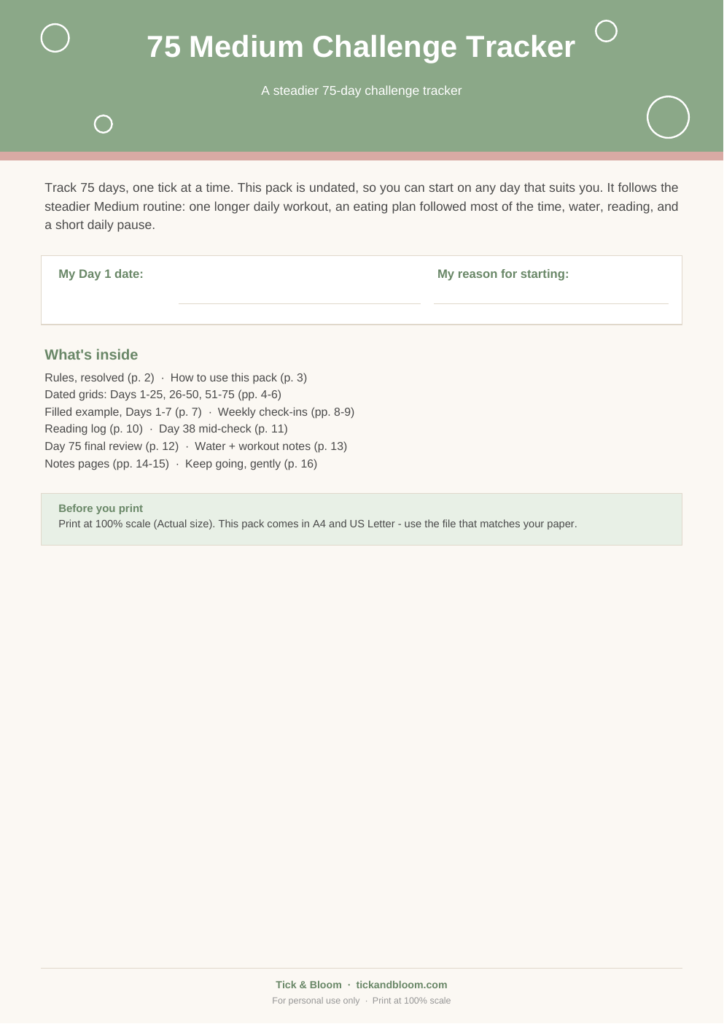
This article uses our 75 Medium Challenge Tracker pack — 16 pages, because a 75-day challenge needs more than a single grid page:
- Cover page with a start-date box, undated so you can begin any day.
- Rules, resolved — the six rules plus the variation box, so your chosen version is written down before Day 1.
- How to use — print, tick as you go, weekly check-in rhythm, and the missed-day rule exactly as stated above.
- Dated grids for Days 1–25, 26–50 and 51–75 — workout / eat well / water / read / pause columns plus photo-day markers and notes, sized for a pen mark.
- A filled example — Days 1–7 filled in, showing ticks, a missed water day, and a short note, so you can see honest use before you start.
- Weekly check-ins for Weeks 1–11, a reading log for Days 1–75, a Day 38 mid-challenge check, and a Day 75 final review.
- Water and workout notes — simple daily log rows for amount and type, as a companion to the grid.
- Notes pages and a closing page to finish the pack.
It comes in A4 and US Letter, and it is free to download from our free printables library. Download your size here:
Frequently asked questions
Is 75 Medium harder than 75 Soft?
Yes, by design: a longer workout, a firmer eating rule, and a daily pause — but without the original’s two workouts, outdoor requirement, or (in this guide) restart rule.
Do I need a daily progress photo?
Not in this guide’s version — weekly (Day 1, weekly, Day 75). Daily-photo versions exist; pick before Day 1.
What happens if I miss a day?
Record it honestly and keep going the next day, under this guide’s version. Do not back-fill ticks you did not earn, and do not restart unless the version you chose before Day 1 requires a restart. Use the weekly check-in to adjust, not to hide the miss.
Can I start on any day?
Yes. The pack is undated: write your Day 1 date on the cover and count forward 75 days from there. Weekends, holidays and busy weeks are ordinary days in the grid, not exceptions to it.
Do I need the printable to do the challenge?
No — the rules work on any paper or notebook. The pack exists because a ready-made grid, a filled example and weekly check-ins remove the daily setup work, and because a printed grid on a wall is harder to forget than a note in a phone.
Start with Day 1, not with a perfect plan
Print the pack, write your version on the rules page, choose your Day 1 date, and tick five boxes tomorrow. The challenge is not won on Day 1 and it is not lost on a single missed day — it is built, one honestly ticked grid at a time, over 75 days. That is the whole system, and it is also why a paper tracker helps: at Day 38 and again at Day 75, the grid shows you exactly what happened, without relying on memory.