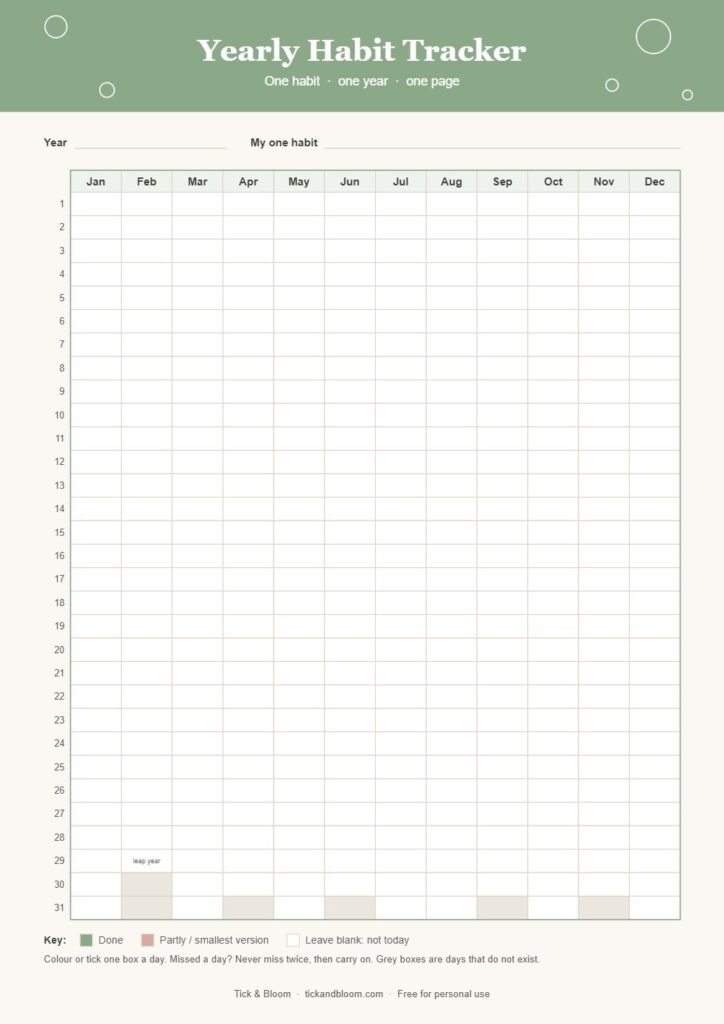
A yearly habit tracker printable lets you follow one habit for a whole year on a single sheet of paper, which makes it the simplest 2027 habit tracker you can start on 1 January. This free pack gives you a one-page year view (12 month columns, 31 day rows), a page of monthly check-ins and a low-ink copy, in A4 and US Letter, with no sign-up.
What is a yearly habit tracker?
A yearly habit tracker is one page that holds every day of the year. Each month is a column and each day is a box, so 365 small ticks build into one picture you can read at a glance: which months flowed, where the gaps gathered, and how far you have come since January.
It works best for one habit at a time. The habit that matters most to you this year (reading, a daily walk, an earlier bedtime, no phone in bed) gets the whole page. If you want to track three to five habits together, use twelve copies of our monthly habit tracker instead. Both downloads are on this page.
What is inside the free pack
- Year at a glance: 12 columns from January to December and 31 rows, with the days that do not exist shaded grey, so an empty box always means a missed day and never a missing date.
- A simple colour key: green for done, rose for the smallest version, blank for not today.
- Monthly check-ins: twelve small boxes for days done, best streak, what helped and one plan for next month.
- A low-ink copy of the year page for home printers.
The pack is undated, so it works for 2027 and for any year after it. Write the year and your habit at the top and start in any month.
How to use the one-page year tracker
- Pick one habit and write its smallest honest version. “Read two pages”, not “read more”. The smallest version is the one you can still do on your worst day of the year.
- Write the year at the top and put the page where the habit happens. A tracker in a drawer gets filled in from memory, and memory is generous.
- Colour one box each day. Use the rose shade on days you only managed the smallest version. That still counts.
- Never miss twice. One empty box is normal. Two in a row is the signal to make the habit smaller, not to give up.
- Fill in the check-in box on the last day of each month. Two minutes is enough: count the days, note what helped, choose one change.
Tracking several habits: the twelve-sheet setup
If one habit is not enough, the monthly pack gives each habit its own row. Print one sheet per month and you have a year of twelve sheets instead of one page. The download is below, and the setup steps follow it.
How to set up the twelve monthly sheets
1. Decide: print all twelve now, or one at a time. Printing all twelve at once feels like a commitment and works well if you have a folder or binder ready. Printing one month at a time is gentler and means a change of plan costs one sheet, not twelve. Either way works — pick the one you will actually do.
2. Choose three to five habits, no more. A year-long page makes it tempting to track everything at once, but a grid with twelve rows usually dies by the second week. Three to five habits is enough to see a pattern and few enough to keep on a tired day. If you are completely new to tracking, start with our pillar guide on how to start a habit tracker you will actually keep — it covers choosing your very first habit and keeping the threshold gentle.
3. Write the smallest honest version of each habit. “Read” is vague; “Read two pages” is a box you can tick. “Go for a walk” becomes “Walk for ten minutes”. The smallest version is the one you can still do on your worst day of the year, and it is the version that keeps the grid alive.
4. Write the month on each sheet before you start. Because the sheets are undated, label them: January, February, and so on — or, if you are starting mid-year, begin with this month and run twelve sheets forward from there. Cross out the boxes that do not exist in short months (February has 28 days, April has 30) before you start, so an empty box never looks like a missed day.
5. Give non-daily habits a target, not a daily box. Some habits are three-times-a-week habits. For those rows, write the weekly target beside the habit name (for example, “×3 per week”) and lightly shade the days that were never planned. At the end of the month you are comparing ticks with the target you actually set, not with a perfect row of 31.
6. Put the page where the habits happen. Kitchen habits belong on the fridge; desk habits belong beside the keyboard. A tracker filed in a drawer is a tracker that gets filled in from memory on Sunday night, and memory is generous in ways that help nobody.
Using it month by month
Tick the box on the same day, ideally straight after the habit. Use one simple mark — a tick, a filled circle, a coloured box — and keep it the same all year so the pages stay easy to read. If you prefer, add a tiny note in the reflection box when a day goes unusually well or badly; one line is plenty.
Expect gaps. A missed day is information, not a verdict, and the kindest working rule is simply to avoid missing twice in a row. Research on habit formation found a median of 66 days for a new behaviour to feel automatic, with a wide range of 18 to 254 days depending on the person and the habit (Lally et al., 2010) — so a year is a generous window, and a missed week in March says nothing about December. If you want a structured version of that long window, our 66-day habit challenge guide runs one habit for 66 days with the same keep-going rule.
Students running this alongside a school schedule will find the same setup works — our habit tracker for students guide shows how to fit study, homework and self-care habits on one monthly grid. And if you are setting up tracking for your children as well, the same gentle approach works there too — our habit tracker for kids guide shows how to run it without turning it into a battle over rewards.
The ten-minute end-of-month review
This is the part most tracker pages leave out, and it is the part that makes next month better. On the last evening of the month, sit down with the finished page and a pen:
- Count (2 minutes). Total the ticks in each row. No commentary yet, just the numbers.
- Compare with the target (2 minutes). Daily habits are judged against the days that existed; three-times-a-week habits against their weekly target, not against 31.
- Spot one pattern (3 minutes). Look for where the gaps gathered — weekends, one weekday, the busy week of the 20th? One honest pattern, not a list of faults.
- Decide keep, shrink or drop (2 minutes). Keep what flowed. Shrink anything that only happened on your best days. Drop, without guilt, anything you plainly do not want; a tracker full of other people’s goals helps no one.
- Carry one lesson forward (1 minute). Write a single sentence at the top of next month’s page: “Evenings work better than mornings”, or “Two habits is my real limit right now”. One lesson per month compounds quietly across a year.
Twelve of those reviews is what turns twelve sheets into a year of evidence about what actually works for you.
Starting mid-year (or in November)
You do not need to wait for January. Because the sheets are undated, a year that starts in November runs November to October, and that is a perfectly good year. Cross out the days that have already passed in the first month and begin today — a three-week page reviewed honestly teaches you more than waiting for a perfect first of the month.
If you are planning ahead for the new year, print the twelve sheets in December, label them, and put January’s sheet where you will see it on the first morning. The rest can wait in the folder until their month arrives.
Frequently asked questions
Is this tracker dated for 2027?
No — the sheets are undated, so they work for 2027 and for any year. Write the month and year on each sheet yourself. That is also why there is no need to re-download next year.
Is there a one-page year-at-a-glance version?
Yes. The yearly pack is built around it: one habit, twelve month columns and 31 day rows on a single page. If you want to follow several habits, use the monthly pack and print one sheet per month instead.
How many habits should I track for a whole year?
Start with three. You can add a fourth or fifth in a later month if the grid still feels light. Adding is easy; recovering from an abandoned page is not. A year is long — the habits that survive it are the small ones.
Which paper size should I print?
A4 if you are in the UK, Europe or most of the world; US Letter if you are in the United States or Canada. Both sizes are in the free download above, and every other pack on our free printables page follows the same two-size rule.
What if I miss a whole week — or a whole month?
Cross out the lost days, keep the rows, and finish the month smaller rather than not at all. A habit with a completely blank row two months running is the tracker doing its job: choose a different habit, or a smaller version. Never back-fill more than a day or two from memory — a partly honest page is worth more than a tidy fiction.
Start your year
Print the grid, choose three habits, write them at their smallest honest size, and put the page where you will see it tomorrow morning. The first month does not need to be impressive — it needs to be finished, reviewed, and followed by a slightly wiser second month. Twelve of those, and you have a year.