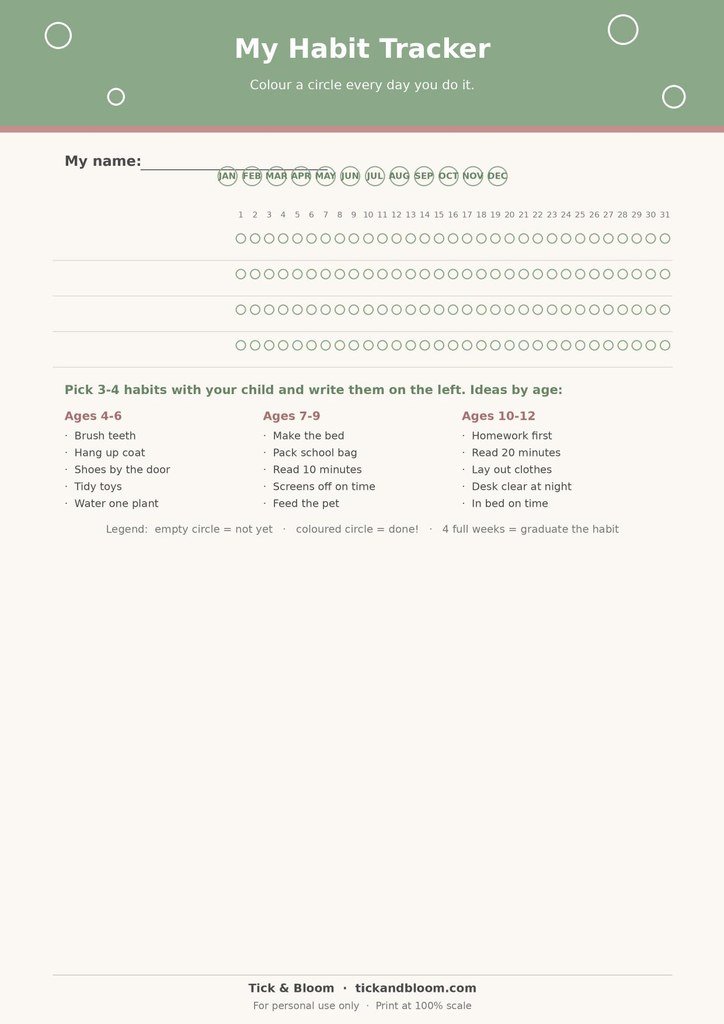
A habit tracker for kids works best as a simple, free printable page that a child ticks each day, rather than a list of reminders from a parent. Start with one page and three to five habits that the child helps to choose, and keep the chart where it can be seen, such as on the fridge. This guide’s own set-up rule is three to five habits only, chosen and decorated by the child, with a fresh start on a Sunday.
Why a tracker works better than reminders
A spoken reminder is personal. “Brush your teeth” lands as criticism, even when you mean it kindly, because it sounds like a verdict on the child. A chart is neutral. Nobody is scolding when the little square for Tuesday stays empty — it is simply an observation, waiting to be filled.
Children are remarkably honest with a grid in front of them. The empty box does what forty reminders cannot: it makes the habit visible, finite, and somehow theirs. Marking it off gives a small, genuine sense of completion, and that sense — not the parent’s approval — is what keeps them coming back.
There is a second, quieter benefit. When you stop being the reminder, the relationship changes. You become the person who notices the streak instead of the person who points out the gap. If you enjoy that shift, you might run a tracker of your own alongside them — our guide to how to start a habit tracker you will actually keep is written for adults, and children love the symmetry of seeing Mum or Dad marking boxes too.
Habit ideas by age
The lists below are starting points, not obligations. Choose together — a habit a child helps to choose is already half-built.
Ages 4–6
Keep it physical and simple. At this age the tracker is mostly a colouring page with a purpose.
- Brush teeth, morning and night
- Hang up their coat when they come home
- Put shoes by the door, not in the middle of the hall
- Tidy toys into the box before dinner
- Drink a glass of water with breakfast (we cover gentle ways to build that routine in our guide to drinking more water daily)
- Water one plant
- Say one thank-you at bedtime
Ages 7–9
This is the golden window. They can write, they care about rules, and they love a streak.
- Make the bed (the five-minute version counts)
- Pack the school bag the night before
- Read for ten minutes
- Screens off at the agreed time
- Help feed the pet, or set the table
- One kind act, noticed and marked
- Rinse the lunchbox
- Tidy the room for five minutes, timer on
School mornings are where most of these habits pay off. If mornings are your battlefield, our calm morning routine guide pairs well with this list — several of the habits above feed straight into a school morning that runs itself.
Ages 10–12
Older children can handle habits with a bit of independence, and they respond well to being trusted with the chart.
- Homework before screens
- Read for twenty minutes
- Lay out clothes for tomorrow
- Practise an instrument or skill for ten minutes
- Keep the desk clear at night
- In bed by lights-out, phone charging elsewhere
- Mark a mood colour on the chart — a simple green, amber, or red key works, and our mood tracking guide explains how to read the pattern without turning it into an interrogation
- One honest review of the day, in a sentence
Bedtime habits deserve special attention at this age, because evenings drift so easily past lights-out. Our guide to tracking sleep patterns for better rest sits alongside this one for exactly that reason.
Set it up in ten minutes
Simplicity is the whole method. Print the tracker — it comes as a free PDF in both A4 and Letter — and put one page per month on the fridge or the inside of a bedroom door, somewhere the child passes daily.
Then follow three rules:
- Pick three to five habits only. Fewer than you think. An empty-heavy chart teaches quitting; a nearly-full one teaches momentum.
- Let the child choose and decorate. They pick from the age list, they colour the header, they own it. A tracker decorated in dinosaur stickers gets marked far more reliably than a pristine one.
- Start on a Sunday. A fresh week on the left-hand side of the page is psychologically cheap to begin; a Wednesday start feels like homework.
The free pack also includes an instructions page and a filled example, which is worth showing them once — children copy what they can see. You can download it from our free printables page.
Running it without bribery battles
This is where most sticker charts go wrong, so it deserves care.
Celebration is not a bribe. A bribe is promised in advance — “finish the week and you get the toy” — and it quietly teaches the child that brushing their teeth is a favour to you. A celebration happens after: hot chocolate on Friday, ten minutes looking at the row of coloured squares together, genuine words about the streak. The difference is timing, and it changes everything.
Make the Friday check-in a small ritual. Sit together, look at the week, and praise the streak, not the prize. “Look at that — twelve in a row” is far more powerful than anything you can buy, because it builds an identity: I am someone who does this.
When a week goes blank, do not punish. A blank week is information, not disobedience. Ask one curious question — “What got in the way this week?” — and then start a fresh line together. Rescuing a broken streak with calm is one of the most useful lessons a tracker can teach.
Use natural consequences, not withdrawn rewards. If the habit was packing the school bag and it didn’t happen, the consequence is coping with the forgotten item at school once — gently, without a lecture. That teaches responsibility in a way that cancelling a promised outing never does.
Keeping it calm when motivation dips
Every tracker fades around week three. That is normal, and it is not a failure — it is a signal to refresh, not to nag harder.
- Graduate finished habits. When a habit runs a full month without a miss, take it off the chart and move it to a “graduated” list on the fridge. Watching that list grow is one of the best motivators you have.
- Rotate monthly. Swap one or two habits for something new each month, with the child’s agreement.
- Make it seasonal. A kindness countdown in December, a leaf-spotting streak in autumn, a water-the-garden run in summer — seasonal habits keep the chart feeling alive.
- Let them rename habits. “Teeth time” beats “brush teeth, morning and night” for a seven-year-old every single time.
The chart is not the point. The point is the child who checks it without being asked — the chart is just what carried them there.
Start with one page
You do not need a system, a chart for every child, or a perfect first month. You need one page, three to five habits, and the patience to let the squares do the asking.
Our Kids Habit Tracker pack is free — a monthly habit grid, A4 and Letter PDFs, with an instructions page and a filled example so your child can see how it works. Print one page tonight, choose three habits together, and see what a calmer evening feels like. A habit tracker for kids free printable is a small thing; the calm it brings is not.
Frequently asked questions
How many habits should a child track at once?
Start with 3 to 5 habits maximum. An uncluttered grid builds daily momentum, whereas a chart with 10 chores overwhelms young children by mid-week.
What are the best habits for 4–6, 7–9, and 10–12 year olds?
Ages 4–6 thrive on concrete physical actions (brushing teeth, hanging up a coat, putting toys in a bin); ages 7–9 enjoy streak-based routines (packing the school bag, 10 minutes of reading, making the bed); ages 10–12 build independence (homework before screens, charging phones outside the bedroom, 20 minutes of reading).
How do I use a kids habit chart without bribing them?
Separate celebration from bribery: avoid promising toys in advance for completed rows, and instead hold a warm Friday check-in over hot chocolate to praise their consistency streak.