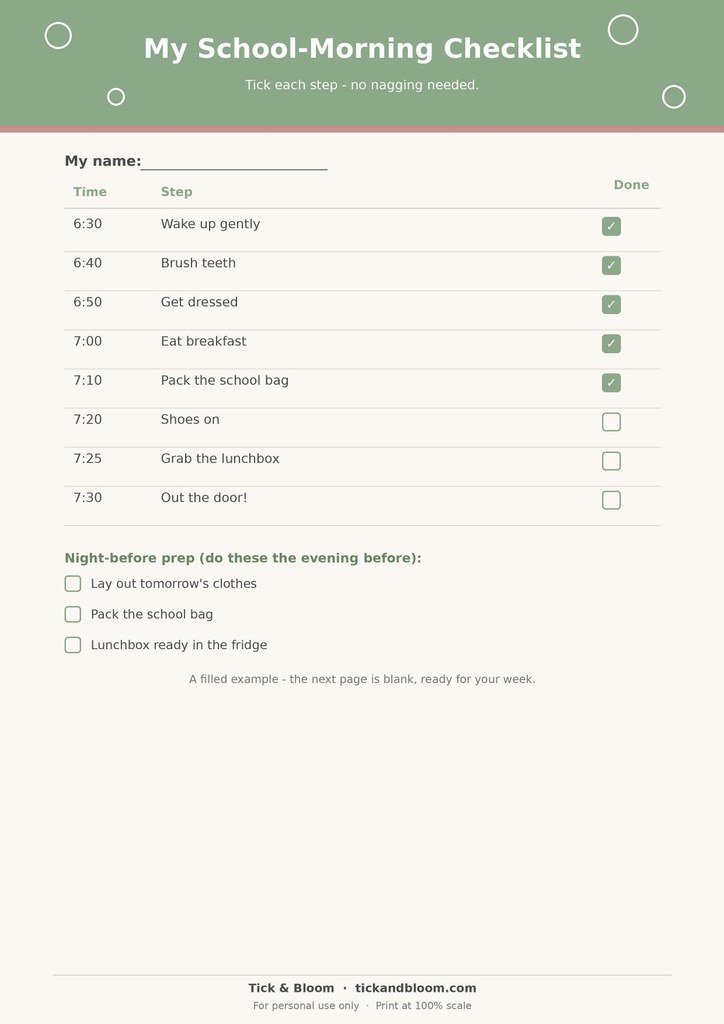
A morning routine checklist for kids printable gives a child one clear, one-page order for the school morning, instead of a stream of spoken reminders. Use the eight steps in this guide, in order, and put the chart where the child can see and tick it. The guide’s own list is eight steps — get dressed, brush teeth, eat breakfast, clear the breakfast spot, shoes on by the door, school bag packed, lunchbox in the bag, and out the door on time — with clothes laid out and the bag packed the night before.
Why your voice is the problem (not the solution)
Every spoken reminder costs attention twice: once for you to notice the undone thing, and once for the child to hear it as criticism. “Shoes on!” at 7:52 is not a neutral instruction — it is the fifteenth instruction of the morning, and it lands with all the weight of the previous fourteen. Children do not tune out because they are difficult; they tune out because the channel is overloaded.
A printed checklist moves the instructions off your voice and onto the wall. The chart does not sigh, hurry, or raise an eyebrow. The empty box for “lunchbox in bag” simply waits. Children check boxes with a satisfaction that has nothing to do with pleasing you — finishing a list is a small victory, and school-age children are wired to chase small victories. Your job shrinks from manager to witness: you notice the completed rows instead of patrolling the unfinished ones.
If you have already felt this shift with evening habits, the same logic powers our habit tracker for kids — the morning checklist is simply the habit tracker compressed into the hardest ninety minutes of the day. The same approach is explained in full in our guide to how to start a habit tracker you’ll actually keep.
The 8 steps that cover every school morning
Start with these eight. Resist the urge to add more; a checklist longer than a child’s attention span becomes wallpaper.
- Get dressed — clothes laid out the night before (step zero, done by you together)
- Brush teeth — morning and night is a habit-track item; the morning half lives here
- Eat breakfast — sitting down, not while walking to the door
- Clear the breakfast spot — bowl in the sink, not the table
- Shoes on, by the door — the single biggest source of last-minute panic, named and tamed
- School bag packed — packed the night before; this step is just the check
- Lunchbox in the bag — the forgotten classic
- Out the door, on time — a finish line worth naming
Run the list in this order and it reads like a story with an ending, which is exactly why children follow it. Each step sets up the next; nothing requires a decision.
The night-before prep that does half the work
Half of every calm school morning happens before bed. This is the quiet engine of the whole system, and it takes ten minutes:
- Clothes chosen and laid out — including socks. Socks are the dark matter of lost time.
- School bag packed — homework in, book bag zipped, parked by the door
- Lunch packed or prepped — fridge-ready, so the morning only needs the transfer
- The checklist visible — stuck on the fridge or taped inside the front door at child height
The night-before routine deserves its own quiet moment because evenings set the tone too. If bedtime is where your household unravels, our guide to tracking sleep patterns sits well beside this one — rested children move faster in the morning without being asked.
Age-by-age tweaks
Ages 4–6: shrink the list to five steps, add pictures if they cannot read yet, and read it with them for the first two weeks. At this age the checklist is a colouring page with a purpose — let them draw a star on finished rows. Small rewards work best as experiences (“ten minutes of the game together tonight”) rather than objects.
Ages 7–9: the full eight steps. This is the golden window — they can read, they love rules, and a streak on the chart genuinely motivates them. Let them take ownership of the ticking-off; a marker on the fridge is a powerful thing.
Ages 10–12: hand over the night-before prep entirely. The checklist becomes a self-check: they run it without you, and you only ask about the row they skipped. Being trusted with the system is the reward.
How to use the printable
Our free Morning Routine Checklist is a one-page chart — print the A4 or US Letter PDF, whichever fits your printer, and stick it where the morning actually happens. Two setups work best:
- The fridge chart: pin it at child height and let them tick with a whiteboard marker if you slip it into a plastic sleeve — reusable all term.
- The door list: tape a copy inside the front door so the last glance before leaving catches “lunchbox in bag”.
Print a fresh copy each month or term. The novelty of a new chart quietly reboots attention — the same trick that keeps a monthly habit tracker alive past the second week.
When the checklist stops working
It will stop working. Usually around week three, the chart becomes invisible and the nagging creeps back. This is not a failure of the system — it is the system telling you it needs a reset:
- Shorten it. Remove the two steps they never miss anymore; mastery earns removal.
- Move it. A chart in a new spot gets noticed again.
- Change the marker. A gold pen, stickers, a stamp — the ceremony matters more than the tool.
- Review together on Sunday. Five minutes: what worked, what was always rushed, what can change.
And once the school mornings run themselves, you may find your own mornings deserve the same treatment. Our calm morning routine guide is the adult version of this system — because the person running the house needs a checklist too.
Get the free printable
Download the free Morning Routine Checklist — one page, A4 and US Letter PDFs, no sign-up — from our free printables library. Print it tonight, lay out the clothes, and let the chart do the talking tomorrow.
Frequently asked questions
What are the 8 steps on the morning routine checklist?
The eight steps are: get dressed, brush teeth, eat breakfast, clear the breakfast spot, shoes on by the door, school bag packed, lunchbox in the bag, and out the door on time.
What night-before prep does the checklist recommend?
Choose and lay out clothes, including socks; pack the school bag; pack or prep lunch; and put the checklist where it can be seen, on the fridge or taped inside the front door at child height.
How should the checklist change for different ages?
Ages 4 to 6: shrink it to five steps, add pictures if they cannot read yet, and read it with them. Ages 7 to 9: use the full eight steps. Ages 10 to 12: hand over the night-before prep entirely, so the checklist becomes a self-check.
What should I do when the checklist stops working?
This usually happens around week three. Shorten it, move it to a new spot, change the marker, or review it together on Sunday for five minutes.