A morning routine checklist for teens is a short, same-order list a teenager runs alone before school — wake, wash, dress, eat, pack, phone rules, out the door. The version below is built for independence: it works without a parent alarm or a parent chasing each step, and the free printable turns it into a tick-off sheet.
That independence is the whole point, and it is what makes this list different from the other morning guides on this site. Our morning routine checklist for kids is parent-run, with a fridge chart and a parent checking each step. Our calm morning routine guide is written for adults who set their own pace. A teenager sits between the two: old enough to run the morning alone, young enough that school, homework and a phone all compete for the same hour. The checklist below is written for that in-between stage, and every step passes one test — could a parent be doing this step instead? If the answer is yes, the step is rewritten so the teenager owns it.
The 7-step teen checklist
Run the steps in this order, every school day. The order matters more than the speed: a list that changes daily is a list that needs deciding, and decisions are what slow a morning down.
- Alarm across the room, phone on charge until dressed. Put the alarm where getting up is part of turning it off, and leave the phone charging while you wash and dress. The phone is step six’s problem, not step one’s.
- Wash and dress from the night-before outfit. Clothes chosen last night, laid out ready — no wardrobe decisions before breakfast.
- Five-minute room reset. Make the bed, put last night’s things away, and put the school bag by the door. Five minutes, timed by the clock, not by feeling.
- Breakfast and water, no scrolling. Eat sitting down, not walking to the door, and keep the phone on charge through this step too.
- Bag check. Homework, books, kit, keys, charger — checked against the timetable for today, not yesterday’s.
- One look at the day. Timetable, one priority for today, anything due. This is the only planning step in the list, and it takes a minute.
- Out the door five minutes early. Set the leaving time five minutes before you actually need it. That buffer is the difference between a missed bus and a calm walk to it.
Print the list and keep it where the morning happens — on a bedroom door, beside a mirror, or inside a planner. Tick each step as it is done, in pen, on paper. The tick is the system: it shows, at a glance, which step is next, without anyone having to ask.
Night-before prep for teens
Half of a calm school morning happens the evening before, and this is the part a teenager can fully own. It takes about ten minutes, and it is worth doing even on evenings when homework runs late:
- Outfit chosen and laid out — including shoes and socks, so the morning holds no clothing decisions.
- Bag packed for tomorrow’s timetable — not today’s, and parked by the door.
- Chargers in one place — phone, laptop or tablet charging overnight, not hunted for in the morning.
- The checklist visible — printed, in the room, where step one starts.
If you already track habits on a monthly grid, the night-before prep fits neatly beside it — our habit tracker for students shows how a school-day grid runs alongside a timetable, and the same “prepare the night before, tick in the morning” rhythm works for both.
Screen and phone rules the teen sets
Phone rules imposed by a parent are rules to work around. Phone rules a teenager sets for themselves are rules they can actually keep, because they chose the trade: a calmer morning in exchange for a phone that waits until the bag check is done.
Try writing your own version of these three rules and sticking them to the checklist:
- Charge overnight, out of reach in the morning. The phone stays on charge until you are dressed and have eaten.
- No scrolling before the bag check. Messages and feeds wait until step five is ticked. Anything urgent will still be there in ten minutes.
- One alarm, one snooze limit. Decide the limit the night before — one snooze, then up — and put the alarm across the room so the decision is already made.
If a rule keeps failing, shrink it rather than dropping it. “No phone until dressed” is easier to keep than “no phone until I leave the house”, and a rule you keep beats a rule you abandon by Wednesday.
Weekend vs school-day tweaks
A checklist that only works on school days will be abandoned by Saturday, and a Saturday list forced onto a school day will be ignored. Keep the same order, change the contents:
- School days: the full seven steps, in order, with the five-minutes-early leaving time.
- Weekends: the same order, shorter list — wake, wash, dress, eat, one plan for the day, out or settled by an agreed time. The point is keeping the order familiar, not keeping the school steps.
- Holidays: drop the bag check and the timetable look, keep the wash, dress, eat and one-plan steps. When term starts again, the school version is a return, not a restart.
Keeping the order the same across all three versions is what makes the school version automatic. You are not learning a new routine each term; you are running the same routine with different steps switched on.
When a morning goes wrong
It will go wrong — a late alarm, a missing book, a bus that leaves early. The checklist has a built-in recovery, and it is simple: go back to step one of what is left, not to the start of the whole list.
If you oversleep, skip the room reset and go straight to wash, dress, eat, bag check, out the door. If the bag check finds something missing, that step is doing its job — better to find it at home than at school. If the whole morning collapses, do not try to make it up by rushing every step; pick the three steps that cannot be skipped (dress, eat, bag) and leave the rest. A partial list, honestly ticked, beats a perfect list that never happened.
And if the same step fails three mornings running, that step is wrong, not you. Change it: move the alarm, pack the bag earlier, or shrink the room reset to two minutes. Our pillar guide on how to start a habit tracker you will actually keep makes the same point for habits — a system that survives is a system that gets adjusted, not abandoned.
What is inside the free pack
This article uses our Morning Routine Checklist v2 pack — a small multi-page pack, because a single checklist page is only half of the system:
- The daily checklist page — the 7-step school-morning list, ready to print and tick.
- A week-at-a-glance grid — the same routine across a full week, so patterns show up.
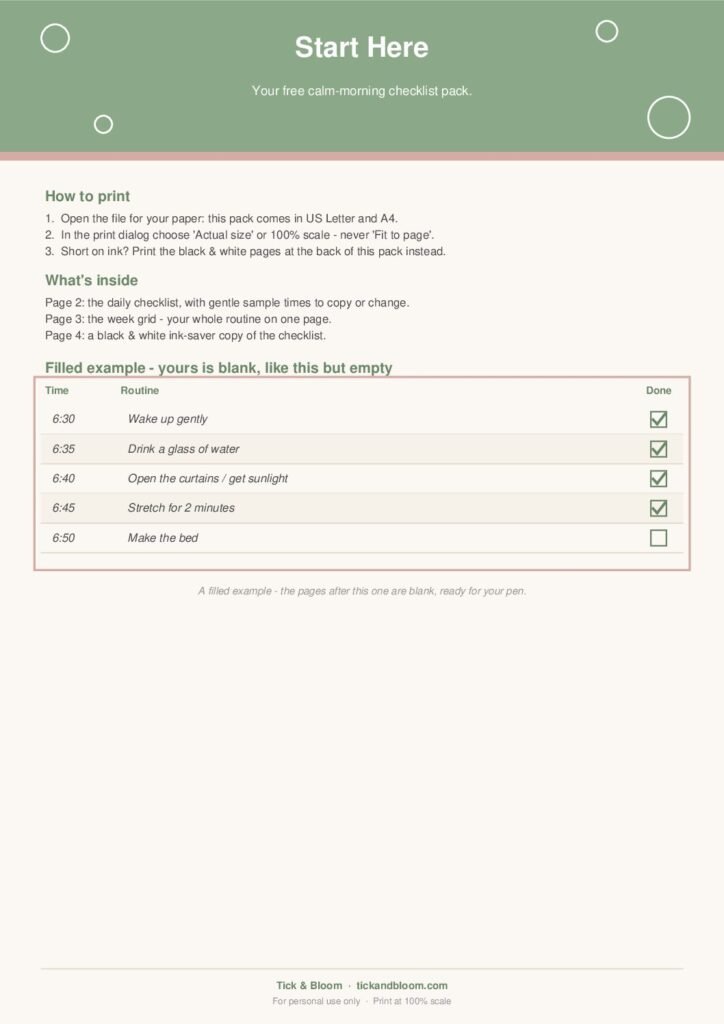
- A filled example page — a completed checklist, so you can see exactly how the ticks and notes work before you start your own.
- An ink-saver copy — a lighter version of the checklist that is kinder to home printers.
It comes in A4 and US Letter, and it is undated, so one download serves every term. Download your size here:
Frequently asked questions
How long should a teen morning routine take?
As long as your school start allows, minus the five-minute buffer in step seven. The checklist itself is not timed — the steps are — so work backwards from your leaving time and give each step a slot. If the total does not fit, shrink a step (the room reset goes from five minutes to two) rather than dropping one entirely.
What if I keep snoozing the alarm?
Move the alarm across the room and decide your snooze limit the night before, when you are not half-asleep. One snooze, then up, is a rule you set awake and keep asleep. If you still snooze past it, the alarm is in the wrong place, not the rule — move it further from the bed.
Paper checklist or phone reminder?
Paper, for this list. A phone reminder opens the phone, and the phone opens everything else — which is exactly what steps one and four are trying to avoid. A printed sheet on the bedroom door shows the next step without a screen, and the tick in pen is visible all morning. If you already use a paper habit grid, the checklist sits beside it naturally.
Start tomorrow morning
Print the checklist tonight, lay out tomorrow’s outfit, pack the bag for tomorrow’s timetable, and put the alarm across the room. Tomorrow, run the seven steps in order and tick each one as it is done. The first morning does not need to be perfect — it needs to be yours, run by you, without anyone chasing each step. That is the whole system, and it is also why it lasts: a routine a teenager owns is a routine a teenager keeps.