A habit tracker for students has one job that generic trackers fail at: it has to fit around a timetable that someone else wrote. Lectures, shifts, homework, exams and social plans already fill the week, so a tracker that demands a perfect morning routine or an hour of journaling before breakfast will be abandoned by Wednesday. What works for students is simpler — one monthly grid, a small set of habits, and a review that takes five minutes, not fifty.
This guide shows how to set up that grid: which habits belong on it, how to run it alongside a school or college schedule, and what to do when a busy week breaks the pattern. The free printable at the end is the same monthly pack our readers already use — undated, so it works for any month of the term.
Why student trackers need a different setup
Most habit tracker advice assumes you control your own day. Students mostly do not. Timetables change between terms, deadlines bunch together, and a week with two exams looks nothing like a normal week. A tracker built for that reality has three differences:
- It tracks fewer habits. Three to five habits is the range that survives a deadline week. A grid with twelve rows looks ambitious on day one and accusing by day ten.
- It separates daily habits from weekly ones. Revision, reading and sleep are daily habits. A library session or a weekly planning slot is not — and judging a three-times-a-week habit against 31 daily boxes is how students conclude, wrongly, that they have failed.
- It plans for the bad week. Exam weeks, illness and family commitments are not exceptions to student life; they are part of it. A tracker that has no plan for a bad week gets thrown away during the first one.
If you are new to tracking altogether, start with our pillar guide on how to start a habit tracker you will actually keep — it covers choosing your very first habit and keeping the threshold gentle. The student setup below builds on exactly that approach.
The student monthly grid: what goes on it
One page, one month, habits down the side and days across the top. Before you write anything, cross out the days that do not exist in that month — February has 28 days, April has 30 — and cross out any days before today if you are starting mid-month. A tracker that begins today is not late; it is honest.
Then choose three to five habits from the starter lists below. Pick from at most two categories to begin with — a grid that tries to cover study, sleep, fitness and social life at once is a grid that gets abandoned.
- Study habits: a 25-minute focused study block; reviewing notes the same day they were taught; starting homework before dinner; reading 10 pages; tidying your desk at the end of a study session.
- Homework and deadline habits: checking tomorrow’s deadlines each evening; breaking one assignment into its next small step; submitting work a day before the deadline, not on it.
- Self-care habits: a regular bedtime; a walk outside between classes; drinking water through the day; one screen-free hour before bed; writing down tomorrow’s three priorities.
Notice what is not on these lists: vague goals. “Study more” is not a habit you can tick. “One 25-minute study block” is. Write the smallest honest version of each habit — the version you can still do on your worst day of term — because that version is what keeps the grid alive.
For younger students, the same gentle approach applies with age-appropriate habits — our habit tracker for kids guide shows how parents can run it without turning it into a battle, and the morning routine checklist for kids covers school mornings specifically.
How to run it with a school schedule
Anchor habits to timetable events, not to clock times. “Study block after lunch” survives a timetable change; “study at 4 PM” does not, because on Tuesdays you have a class at 4 PM. Tie each habit to something that already happens every day: after breakfast, between classes, straight after your last lesson, before bed.
Give weekly habits a weekly target. Write the target beside the habit name — for example, “Library session ×3 per week” — and lightly shade the days that were never planned. At the end of the month you compare ticks with the target you actually set, not with a perfect row of 31.
Put the page where study happens. Beside the keyboard, inside the front of a folder, or on the wall above the desk. A tracker filed in a drawer gets filled in from memory on Sunday night, and memory is generous in ways that help nobody. Tick the box on the same day, straight after the habit, with one simple mark kept the same all month.
Use the monthly rhythm, not a 30-day challenge. Months are how student life actually runs — terms, deadlines and exam seasons all follow the calendar. Our monthly habit tracker printable guide explains the end-of-month review in full; the student version below borrows its short form.
The 5-minute weekly review
Once a week — Sunday evening works for most students — sit down with the grid for five minutes:
- Count (1 minute). Total the ticks in each row. No commentary yet, just the numbers.
- Spot one pattern (2 minutes). Where did the gaps gather — weekends, one heavy weekday, the week a deadline landed? One honest pattern, not a list of faults.
- Decide keep, shrink or drop (2 minutes). Keep what flowed. Shrink anything that only happened on your best days — the smallest version was still too big. Drop, without guilt, anything you plainly do not want; a tracker full of other people’s goals helps no one.
That is the whole review. It is deliberately short because a review that takes half an hour becomes a chore students skip — and a skipped review is how a tracker quietly dies.
When a week goes off track
It will happen, usually in exam season. Three things help. First, never back-fill more than a day or two from memory — a partly honest page is worth more than a tidy fiction. Second, restart where you are: cross out the lost days, keep the rows, and finish the month smaller rather than not at all. Third, a habit with a completely blank row two months running is the tracker doing its job — choose a different habit, or a smaller version of it.
One rule covers most bad weeks: avoid missing twice in a row. A single missed day is information. Two in a row is the start of a new pattern, and noticing it early is exactly what the weekly review is for.
What is inside the free pack
This article uses our Habit Tracker v2 monthly pack — a small multi-page pack, because the grid alone is only half of the system:
- The month’s main grid — space for your habits and for each day, with a reflection box underneath.
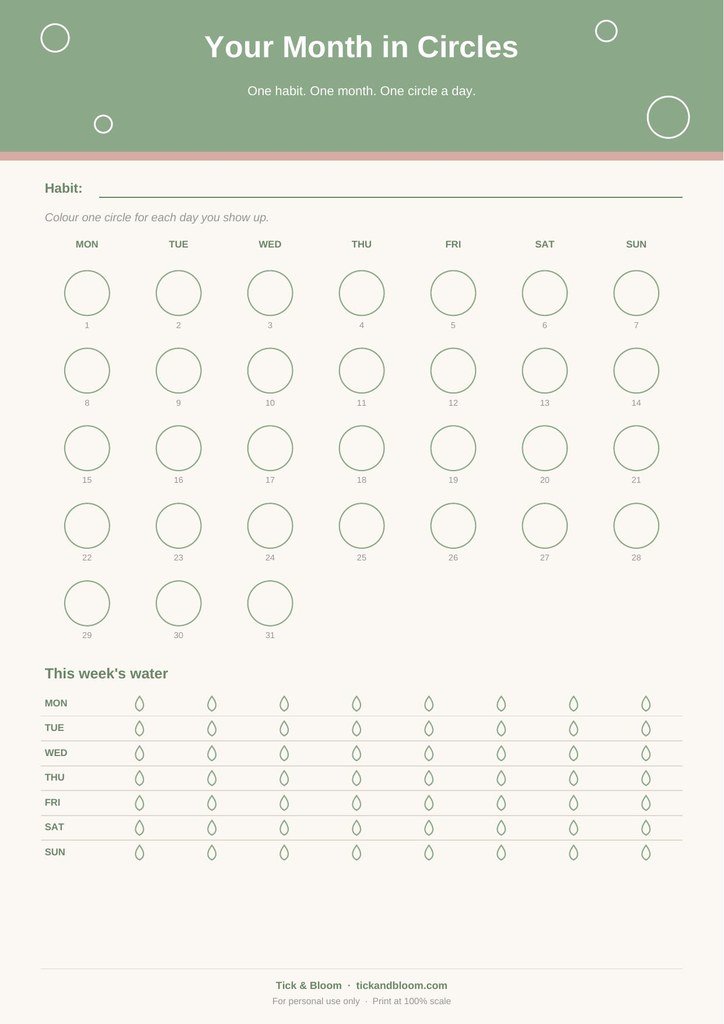
- A Month in Circles page — one circle a day, for a single habit you want to keep an eye on.
- A filled-in sample — a finished tracker that shows the marks, notes and reflection box in use before you try your own.
- An ink-saving copy — a paler print of the tracker that is easier on a home printer.
- A weekly water strip — a handy extra for the water habit almost everyone tracks first.
It comes in A4 and US Letter, and it is undated, so one download serves every month of the school year. Download your size here:
Want a page for the day itself, not only the habits? Pair this grid with our daily planner printable for students. If starting and staying focused is the hard part, our habit tracker for ADHD guide shows a lighter way to set up the same grid.
Frequently asked questions
Is a paper tracker better than an app for students? Neither is universally better — it depends on what you will actually open. Paper wins for students who already spend all day on screens and want their habits visible beside their desk; apps win for students who lose paper. The grid in this guide works in either form, but the free printable here is paper, so choose it if a page on your desk is what you will actually see.
How many habits should a student track? Start with three. You can add a fourth or fifth next month if the grid still feels light. Adding is easy; recovering from an abandoned page is not.
What if I miss a whole week? Cross out the lost days and keep going — do not back-fill a week from memory and do not wait for the first of next month. One honest partial month teaches you more than a perfect month that never happened, and the weekly review will show you exactly which week broke and why.
Which paper size should I print? A4 if you are in the UK, Europe or most of the world; US Letter if you are in the United States or Canada. Both sizes are in the free download above, and every other pack on our free printables page follows the same two-size rule.
Start this month
Print the grid, choose three habits at their smallest honest size, and anchor each one to something that already happens in your school day. Run the five-minute review on Sunday. The first month does not need to be impressive — it needs to be finished, reviewed, and followed by a slightly wiser second month. That is the whole system.