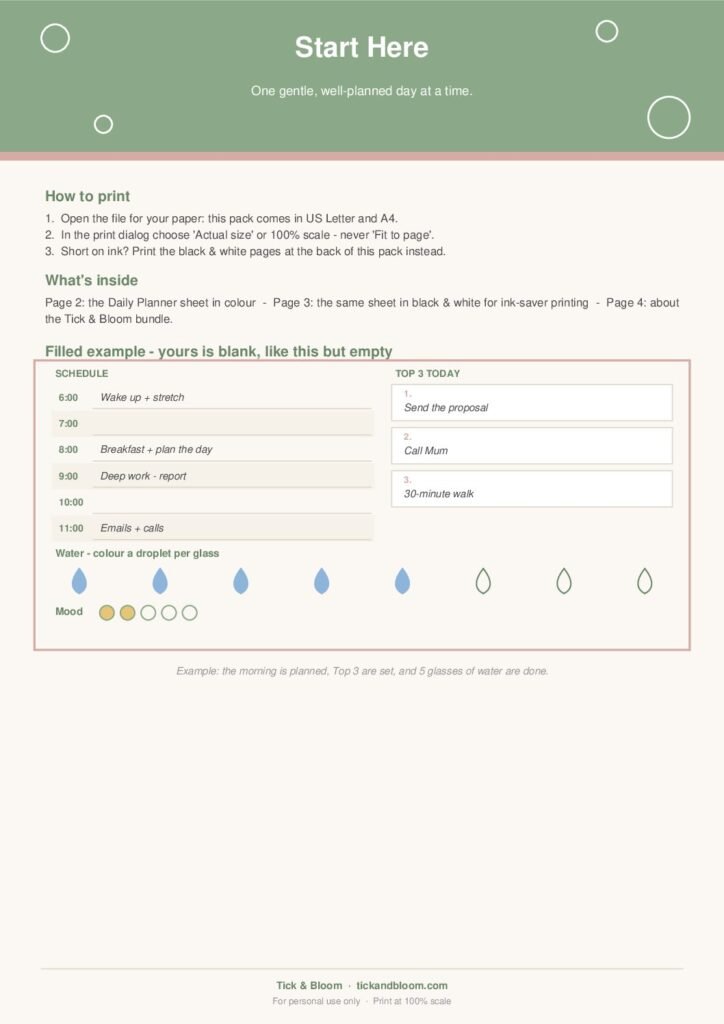
A daily planner printable for students is a one-page hourly sheet that fits a school day: classes go in first, then study blocks, homework and deadlines fill the gaps around them, and a short Top 3 list keeps the day honest about what actually matters. This free printable does exactly that — one page per day, with an hourly schedule, a Top 3 list, a water row and a quick mood check-in — in A4 and US Letter.
Most daily planners fail students for a simple reason: they assume you choose how your day looks. Students mostly do not. Someone else wrote the timetable, so a planner that starts with a blank day and a motivational quote is a planner that gets ignored by second period. A student planner works the other way round — the timetable goes in first, and everything else is planned around it.
Why a student day needs its own planner
A working day and a school day are different shapes. A school day is chopped into fixed blocks — lessons, lunch, travel, clubs — with short gaps in between that are easy to waste and hard to use. Three things follow from that shape:
The fixed blocks come first. Classes, exams and travel are not negotiable, so they go on the page before anything else. A plan that pretends you have eight free hours will collapse by 9 AM; a plan built around the hours you actually control will survive the day.
The gaps are where the work happens. A 25-minute study block fits between lessons. Homework starts in the gap after your last class, not at some ideal evening hour that never arrives. The planner’s job is to make those gaps visible so they get used instead of scrolled away.
One page is enough. A student day has a natural end — bedtime — and a planner that runs past it is a planner that lies. One page, one day, finished when the day is finished. Tomorrow gets a fresh page.
If you already track habits across the month, this daily sheet is its partner, not its replacement. Our habit tracker for students guide shows how the monthly grid runs alongside a timetable; the daily planner below is what you use inside a single day.
What is on the sheet
The free pack is four pages: the daily sheet in colour, a black & white ink-saver copy of the same sheet, a how-to-print page, and a filled example so you can see exactly how a finished day looks before you start your own. The sheet itself has four parts:
The hourly schedule. One line per hour, from morning to bedtime. Write the fixed blocks in first — classes, lunch, travel, clubs — then fill the gaps with study, homework and the things you chose. An hour with nothing written in it is a decision, not an accident, once it is on the page.
The Top 3 list. Three things that would make today count, written before the day starts. Not ten — three. If everything on the schedule gets done except the Top 3, the day still failed; if only the Top 3 get done, the day still worked. That is the test the list is for.
The water row. A row of droplets to colour in, one per glass through the day. It is a small thing on purpose — a planner that also tracks water is a planner that reminds you to drink without needing a second page for it.
The mood dots. A quick end-of-day check-in: colour one dot for how the day felt. Over a week, the dots show the pattern — which days run well and which ones keep falling apart — without any extra journalling.
Fill it in five minutes
The sheet takes five minutes, and it works best the night before or first thing in the morning. Either way, the order is the same:
- Write the fixed blocks (1 minute). Classes, travel, clubs, anything with a set time. This is the skeleton of the day — nothing else is planned until it is in.
- Pick the Top 3 (1 minute). Look at tomorrow’s deadlines and today’s unfinished work, then choose three. If a deadline lands tomorrow, it is on the list; if it does not, it probably is not.
- Place the study and homework (2 minutes). Fit study blocks and homework into the gaps between the fixed blocks. A 25-minute block between lessons counts. So does starting homework straight after your last class instead of “later”.
- Leave one gap empty (1 minute). Deliberately. A day with no slack breaks at the first surprise — a late bus, a longer lesson, a question that needs an answer. One empty hour is the plan surviving contact with reality.
Keep the finished page where the day happens: beside the keyboard, inside the front of a folder, or on the wall above the desk. A planner filed in a bag gets filled in from memory at bedtime, and memory is generous in ways that help nobody.
Study blocks and deadlines around classes
Anchor study to timetable events, not to clock times. “Study block after lunch” survives a timetable change; “study at 4 PM” does not, because on Tuesdays you have a class at 4 PM. Tie each block to something that already happens every day: after breakfast, between classes, straight after your last lesson, before bed.
Work deadlines backwards onto the page. A deadline on Friday means a block on the planner on Wednesday and Thursday, not a panic on Friday morning. Write the deadline in the hour it is due, then put the preparation blocks on the days before it. Our monthly habit tracker printable guide explains the same backwards-planning habit for the whole month; the daily sheet is where it lands on a single day.
Protect one block for revision. Reading notes the same day they were taught takes twenty minutes and saves hours later. It is the easiest block to skip and the most useful one to keep, so put it in the same gap every day until it is a habit rather than a decision.
Mornings set the day. If mornings are the hard part, the morning routine checklist for teens covers the same ground for the first hour — wake up, get ready, leave on time — and the daily planner takes over from there.
When the day goes off plan
It will, usually by mid-morning. Three things help. First, cross out and rewrite rather than starting a new page — a messy page that was used beats a clean page that was abandoned. Second, protect the Top 3: if the schedule falls apart, the three things still decide whether the day worked. Third, never carry an unfinished list into tomorrow as guilt — rewrite tomorrow’s Top 3 fresh, and let today be what it was.
One rule covers most bad days: a single missed block is information, not failure. Two missed days in a row is the start of a pattern, and noticing it early is exactly what the mood dots and the evening check-in are for.
What is inside the free pack
This article uses our Daily Planner pack — four pages, because the sheet alone is only half of the system:
- The daily sheet (colour) — the hourly schedule, Top 3 list, water droplet row and mood dots on one page.
- An ink-saver copy — the same sheet in black & white, kinder to home printers.
- A how-to-print page — paper and print settings, so the sheet comes out the right size.
- A filled example page — a completed day, so you can see exactly how the hours, the Top 3 and the mood dots work before you start your own.
It comes in A4 and US Letter, and it is undated, so one download serves every day of the school year. Download your size here:
Frequently asked questions
Is a paper planner better than an app for students?
Neither is universally better — it depends on what you will actually open. Paper wins for students who already spend all day on screens and want the day visible beside their desk; apps win for students who lose paper. The sheet in this guide works on paper, so choose it if a page on your desk is what you will actually see.
How is this different from the monthly habit tracker?
The habit tracker watches patterns across a month — which habits held, which weeks broke. The daily planner runs a single day — what happens in each hour, and which three things matter today. They work together: the monthly grid shows the pattern, the daily sheet shapes the day. Our pillar guide on how to start a habit tracker you will actually keep explains the monthly rhythm in full.
Which paper size should I print?
A4 if you are in the UK, Europe or most of the world; US Letter if you are in the United States or Canada. Both sizes are in the free download above, and every other pack on our free printables page follows the same two-size rule.
Start tomorrow
Print a few sheets, fill in tomorrow’s fixed blocks tonight, and pick three things that would make the day count. Run it for a week — same five minutes, same page, same Top 3 test — and let the mood dots tell you which days work and which ones need a different shape. The first week does not need to be impressive. It needs to be finished, looked at honestly, and followed by a slightly wiser second week. That is the whole system.