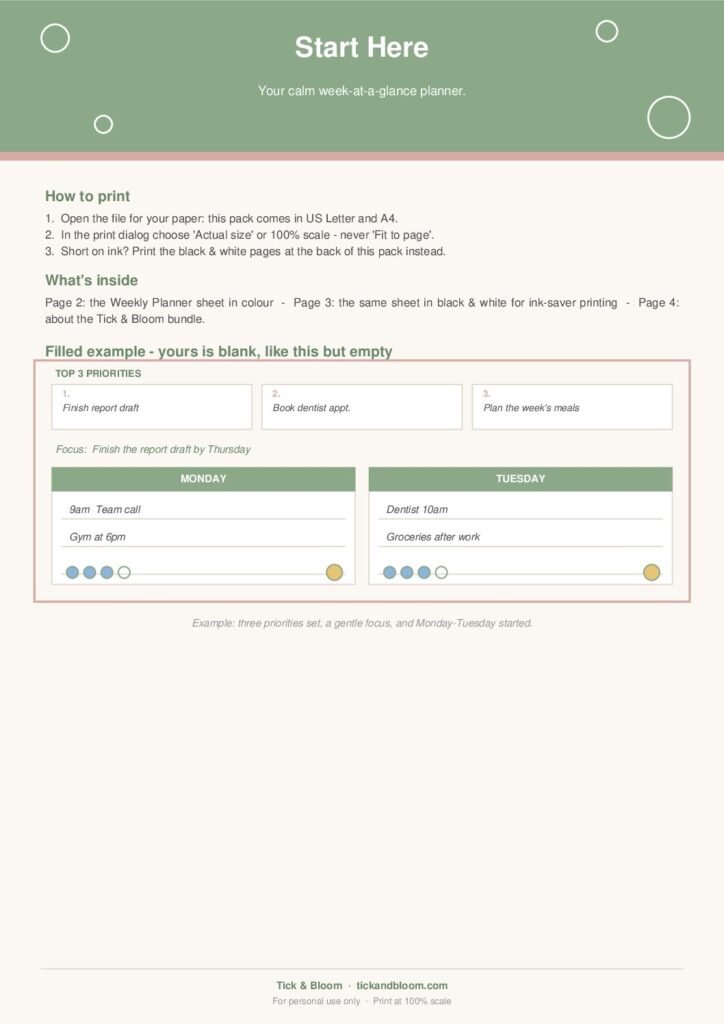
A free weekly planner printable lets you see your whole week on one page: three priorities, one focus, and a column for each day. Download it below in A4 or US Letter, print it, and plan your week in about ten minutes on Sunday — then review last week in the same ten minutes.
Most weekly planners fail for the same reason most habit trackers fail: they ask for too much. A page crammed with hourly boxes, meal plans, water goals, and a gratitude line turns into a second job, and by Wednesday it sits blank. This planner does the opposite. It holds three priorities, one weekly focus, and seven day-columns — nothing else. That is enough to run a week, and small enough that you will actually use it again next Sunday.
What’s in the free pack
The pack is four pages, and every page earns its place:
- Page 1 — how to print. Open the file for your paper size, choose “Actual size” or 100% scale in the print dialog, and never “Fit to page”. Short on ink? Print the black & white pages at the back instead.
- Page 2 — the weekly sheet in colour. Top 3 priorities at the top, one weekly focus line, and a column for each day of the week.
- Page 3 — the same sheet in black & white. An ink-saver copy for everyday printing.
- Page 4 — a filled example. A finished week, already written in, so you can see how the page is meant to look before you write on your own blank copy.
The sheet is undated, so the same file works for this week, next week, and every week of any year. Print one copy per week, or print a small stack and keep them in a folder by the kettle.
The 10-minute Sunday plan
Pick a regular ten minutes — Sunday evening works for most people, but any quiet slot before Monday does the job. Work through these five steps in order, and stop at ten minutes even if the page is not perfect. A finished rough plan beats an unfinished perfect one.
1. Look back before you look forward (2 minutes). Glance at last week’s sheet. Which days went as planned, and which ones slipped? You are not grading yourself; you are collecting facts. One line of notes in the margin is enough: “Tuesday ran over — gym moved to Thursday.”
2. Choose your top 3 priorities (2 minutes). Not ten. Three things that, if they happen this week, make the week a good one. Write them at the top of the sheet. Everything else is a bonus, not a failure. If you are tracking habits, this is where your habit tracker earns its keep: the three habits you most want to keep this week are often the same three priorities.
3. Pick one weekly focus (1 minute). A single sentence that names what this week is about: “Finish the report draft by Thursday.” “Three home-cooked dinners.” “A calm morning before school runs.” The focus is the tie-breaker — when two things compete for the same evening, the focus decides.
4. Fill in the fixed points (3 minutes). Put the immovable things in their day-columns first: work shifts, school runs, appointments, deadlines, classes. What is left is your real free time, and it is usually smaller than it felt in your head. That is useful information, not bad news — a plan built on real hours holds up; a plan built on imagined hours collapses by Tuesday.
5. Give the three habits a time slot (2 minutes). This is the step most planners skip, and it is the one that matters most. A habit without a time is a wish. Pick the three habits from step 2 and write each one into a specific slot on a specific day — “walk, 7am, Monday/Wednesday/Friday” beats “walk more” every time. The next section shows how to do this without overfilling the page.
Time slots: how to give three habits a home
The “weekly planner printable with time slots” idea sounds fussy — an hourly grid for seven days is a lot of boxes. This sheet takes a lighter approach: you keep the open day-columns, and you write the time next to the habit, in plain words.
- One slot per habit per day, not a full timetable. “Read 10 pages, 9pm” is a slot. You do not need to schedule every hour.
- Attach the habit to something that already happens. “Water the plants after breakfast” and “stretch while the kettle boils” survive better than habits floating in empty time, because the anchor reminds you.
- Three habits maximum. The sheet has room for more, but your week does not. If you are running a longer challenge, the same rule applies: the 66-day habit challenge works one habit at a time for exactly this reason.
- Put the hardest habit earliest. Mornings are the most reliable hours most people have. If a habit matters, give it the morning slot and let the easy ones take the evening.
- Leave one day blank on purpose. A week with no slack in it breaks at the first surprise. Keep one evening, or one morning, deliberately empty. When something overruns — and something always does — the empty slot absorbs it instead of the plan falling apart.
A filled example from the pack shows what this looks like in practice: “Finish report draft” as priority one, “Book dentist appt.” as priority two, “Plan the week’s meals” as priority three, with the focus “Finish the report draft by Thursday”. Monday holds a 9am team call, Tuesday a 10am dentist appointment, and the gym at 6pm. Nothing is over-scheduled; every day has white space left in it.
The 10-minute week review
Planning is only half the page’s job. The other half is the review — and it takes the same ten minutes, at the end of the week, before you plan the next one.
Count starts, not streaks. Look at your monthly habit tracker beside the weekly sheet. How many days did each habit actually start? A habit you started four times out of seven is a habit that is working. A blank day breaks nothing — Lally and colleagues’ 2010 study of habit formation found that missing a single occasion did not derail later progress, and the weekly review is where you see that plainly instead of feeling it as failure.
Carry over, don’t re-plan. Anything unfinished moves to next week’s sheet in one line — no re-thinking, no guilt tax. If the same item carries over three weeks running, that is a signal: either it is not really a priority (drop it) or it needs a smaller first step (shrink it).
Ask one question. “What made the good days work?” The answer is usually boring and useful: the walk happened on the days you laid out shoes the night before; the reading happened on the nights the phone charged in the kitchen. Next week’s plan copies whatever worked. That is the whole review.
When the week goes wrong
Some weeks will not follow the sheet. A child falls ill, work runs late three nights in a row, a deadline moves. The planner is not a promise — it is a starting point, and the honest move is to re-plan in two minutes rather than abandon the week.
- One bad day is one bad day. Cross it out, write the new plan underneath, and keep going. The sheet is paper; it does not judge.
- A busy week gets a smaller plan. Cut the top 3 to a top 1. One priority kept is better than three priorities missed.
- A missed habit is a note, not a verdict. Write why it slipped — “late meeting” is a reason you can plan around next week; “no reason” usually means the slot was wrong, not the habit.
- Never restart the week. There is no rule that says a messy Monday means the week is lost. The keep-going rule in our challenge guides applies here too: record the week honestly, adjust the next one, and carry on.
Pair it with your habit tracker
A weekly planner and a monthly habit tracker do different jobs, and they work better together than either does alone. The tracker shows the pattern across a month; the planner shows the week you are actually living in. Use them as a pair:
- Sunday: plan the week on this sheet, and pick the three habits that get time slots.
- Daily: tick the habits on your monthly habit tracker printable as you do them — one row per habit, one mark per day.
- Next Sunday: review both pages together. The tracker tells you which habits held; the planner tells you why — which slots worked and which ones never stood a chance.
If you plan your days as well as your weeks, the daily planner printable for students uses the same top-3 idea at day level: three things for today, an hourly sheet, and a quick mood check at the end. The system is the same at every scale — three priorities, one focus, and a review that takes ten minutes.
Frequently asked questions
Is this weekly planner printable really free?
Yes. Both PDFs — A4 and US Letter — are free to download and print as many times as you like, with no sign-up and no email address. Print one copy per week, or a stack for the month.
A4 or US Letter — which file do I need?
Pick the one that matches your paper. A4 is the standard size in the UK, Europe, and most of the world; US Letter is the standard size in the United States and Canada. The pages are the same in both files — only the paper size changes. The how-to-print page in the pack explains the print settings.
Is the planner dated?
No. The sheet has no dates printed on it, so the same file works for any week of any year. Write the week’s dates in by hand at the top when you plan.
Can I use it every week?
That is what it is made for. It is a single reusable sheet: print a fresh copy each Sunday, plan, review, and start again. If you prefer a digital copy, the PDF opens in any PDF reader, and you can write on it with a tablet pen.
Does it work with the Tick & Bloom habit tracker?
Yes — they are designed as a pair. The weekly planner holds the week’s priorities and time slots; the monthly habit tracker holds the day-by-day record. Both are free, and both live on the free printables library.
Tick & Bloom makes free printable trackers and planners for calm, realistic routines. Browse the full free printables library for habit trackers, morning routine checklists, and daily planners.