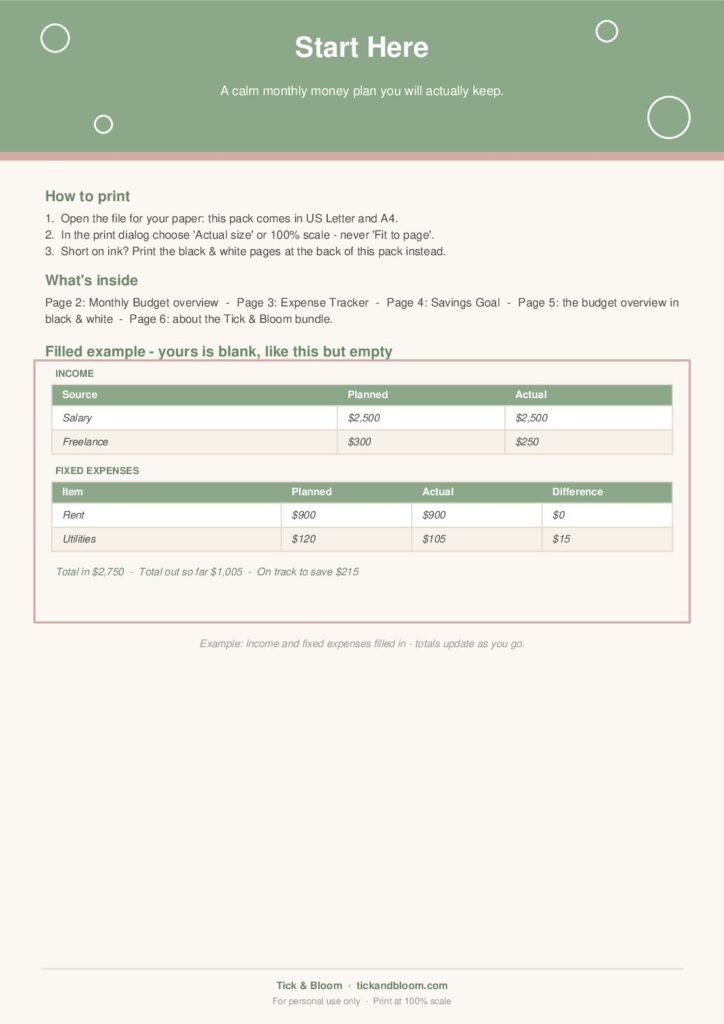
A monthly budget planner printable puts your whole month of money on one calm page: what comes in, what has to go out, what you plan to spend and what you actually spent. This free 6-page pack gives you that page plus an expense tracker and a savings goal sheet, in A4 and US Letter, with no sign-up.
It is not a finance course and it will not tell you what to do with your money. It simply makes the numbers visible, which is the step most budgets skip.
What is a monthly budget planner?
A monthly budget planner is a page you fill in twice: once at the start of the month with your plan, and again at the end with what really happened. The gap between the two columns is where the useful information lives. A planned grocery spend of 300 that became 410 tells you more than any app notification.
Paper works well here for the same reason it works for habits: writing a number by hand makes you notice it. You cannot scroll past a figure you had to write down yourself.
What is inside the free pack
- Monthly budget overview: income, fixed expenses (rent, bills, subscriptions) and flexible spending, each with a planned and an actual column and a difference column to check at a glance.
- Expense tracker: a running list of what you spend through the month, with date, item, category and amount.
- Savings goal page: one goal, one target amount and a simple fill-in tracker to watch it grow.
- A black and white copy for printing at home without colour ink.
- A how-to-print page and a filled example, so you can see a finished month before you start yours.
The pack is undated and works in any currency. Write your own symbol next to the figures.
How to set up your month in fifteen minutes
- Write your income first. Only money you are sure of this month. If your income changes from month to month, use the lowest recent figure as your plan and treat anything above it as a bonus.
- List fixed expenses next. Rent or mortgage, bills, loan payments, subscriptions, school fees. These are the lines that do not change much, so they take a few minutes once and then mostly copy across.
- Plan your flexible spending. Groceries, transport, eating out, clothes, gifts. Write a planned figure for each, even if it is a guess. A rough plan you can compare against beats a perfect plan you never write.
- Set one savings line. Even a small fixed amount. Copy it onto the savings goal page so you can watch it build.
- Check that the plan adds up. Income minus fixed expenses minus planned spending minus savings should not go below zero. If it does, change the flexible lines now, on paper, rather than at the end of the month.
Using it through the month
Keep the expense tracker somewhere you will see it: inside a kitchen drawer, on the fridge, in the folder with your receipts. Add each spend the same day, or once each evening from your banking app. It takes two minutes, and two minutes daily is far easier than an hour of detective work on the 30th.
If daily recording sounds like a habit you would forget, treat it as one. Add “Log today’s spending” as a row on our monthly habit tracker and tick it like any other habit.
The end-of-month review
On the last day of the month, fill in the actual column from your expense tracker and work out the difference for each line. Then ask three questions:
- Which line went over, and why? One honest reason, not a list of excuses. A birthday, a car repair, takeaway on tired evenings.
- Which line came in under? That is money you can move to savings or to the line that keeps going over.
- What is one change for next month? Raise a plan that was unrealistic, or lower one you never use. Small adjustments each month build a budget that fits your real life.
If you also plan meals, the two pages work well together: a weekly meal planner is one of the simplest ways to bring a grocery line back to its plan.
Frequently asked questions
Is this budget planner free?
Yes. The full 6-page pack is free to download and print for personal use, with no email or sign-up.
Does it work for any currency?
Yes. There are no currency symbols printed on the sheets, so you can use pounds, dollars, euros, rupees or anything else.
Should I use a budget app instead?
Use whichever you will actually keep. Many people find an app good for recording and paper better for planning and reviewing, because the whole month sits on one page in front of them. You can also use both: record in your banking app, then copy the totals onto the paper overview once a week.
What if my income changes every month?
Plan with the lowest income you have had in the last few months. If more arrives, decide on paper where it goes before you spend it: savings, a bill paid early, or one planned treat.
Which paper size should I print?
A4 for the UK, Europe and most of the world; US Letter for the United States and Canada. Every pack on our free printables page comes in both sizes.
Start this month
Print the overview, write your income and fixed expenses tonight, and put the expense tracker where you will see it tomorrow. The first month does not have to be accurate. It has to be finished, so the second month can be better.