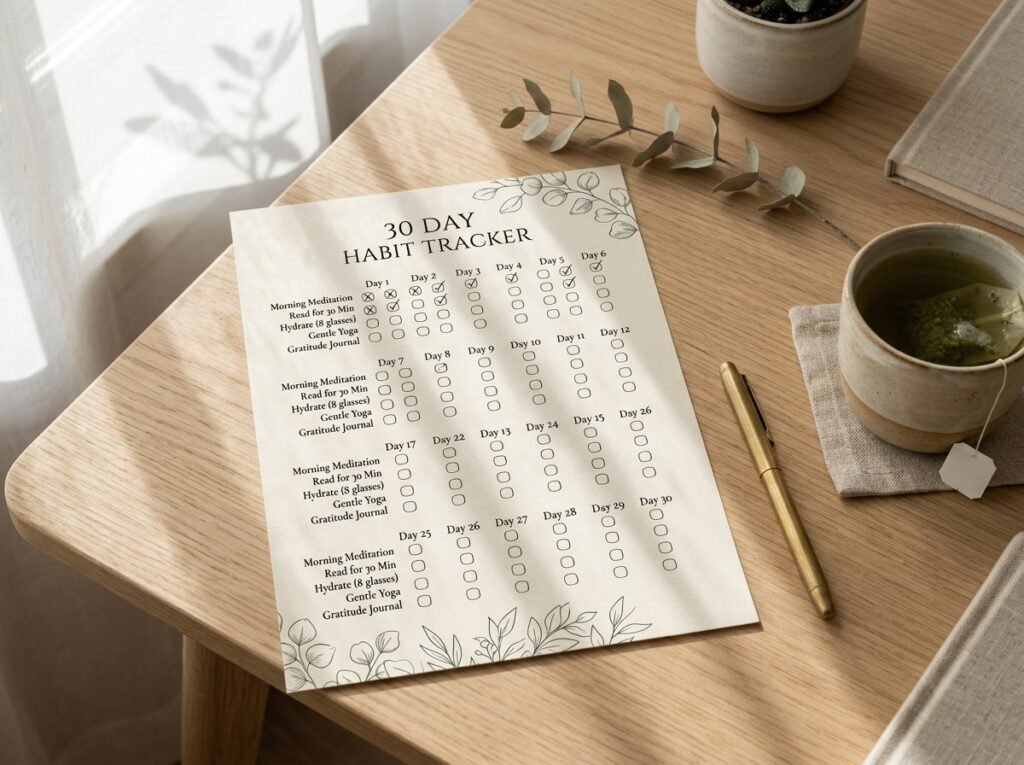
A monthly habit tracker printable is the simplest way to see a whole month of effort on one page: your habits down the side, the days of the month across the top, and one small box to fill in each day you show up. No app, no account, no streak counter quietly judging you — just a grid that tells the truth at a glance.
Monthly tracking suits real life better than a strict 30-day challenge, because months are how we actually plan: rent, paydays, school terms and shift patterns all run by the calendar. This guide covers choosing your habits, setting up the grid properly (including short months and habits you only do a few times a week), and a calm ten-minute review that turns one month of ticks into a better plan for the next.
Monthly, weekly or 30-day: which grid do you need?
The three formats look similar, but they do different jobs. A weekly tracker is best for routines that repeat inside a week, such as a morning checklist. A 30-day tracker is a set challenge window that can start on any date. A monthly habit tracker follows the calendar month itself, which makes it the easiest one to review: when the month ends, the page ends, and you can compare January with February without any maths.
If you are completely new to tracking, start with our pillar guide on how to start a habit tracker you will actually keep — it covers choosing your very first habit and keeping the threshold gentle. Come back here when you are ready to run the monthly rhythm.
Planning your days as well as ticking habits? Our free weekly planner printable gives you one calm page per week. And if you want to run a whole year, the yearly habit tracker guide shows how to use twelve of these monthly sheets as one simple year.
What is inside the free pack
Most monthly habit tracker printable downloads are a single page. Ours is a small multi-page pack, because the grid alone is only half of the system:
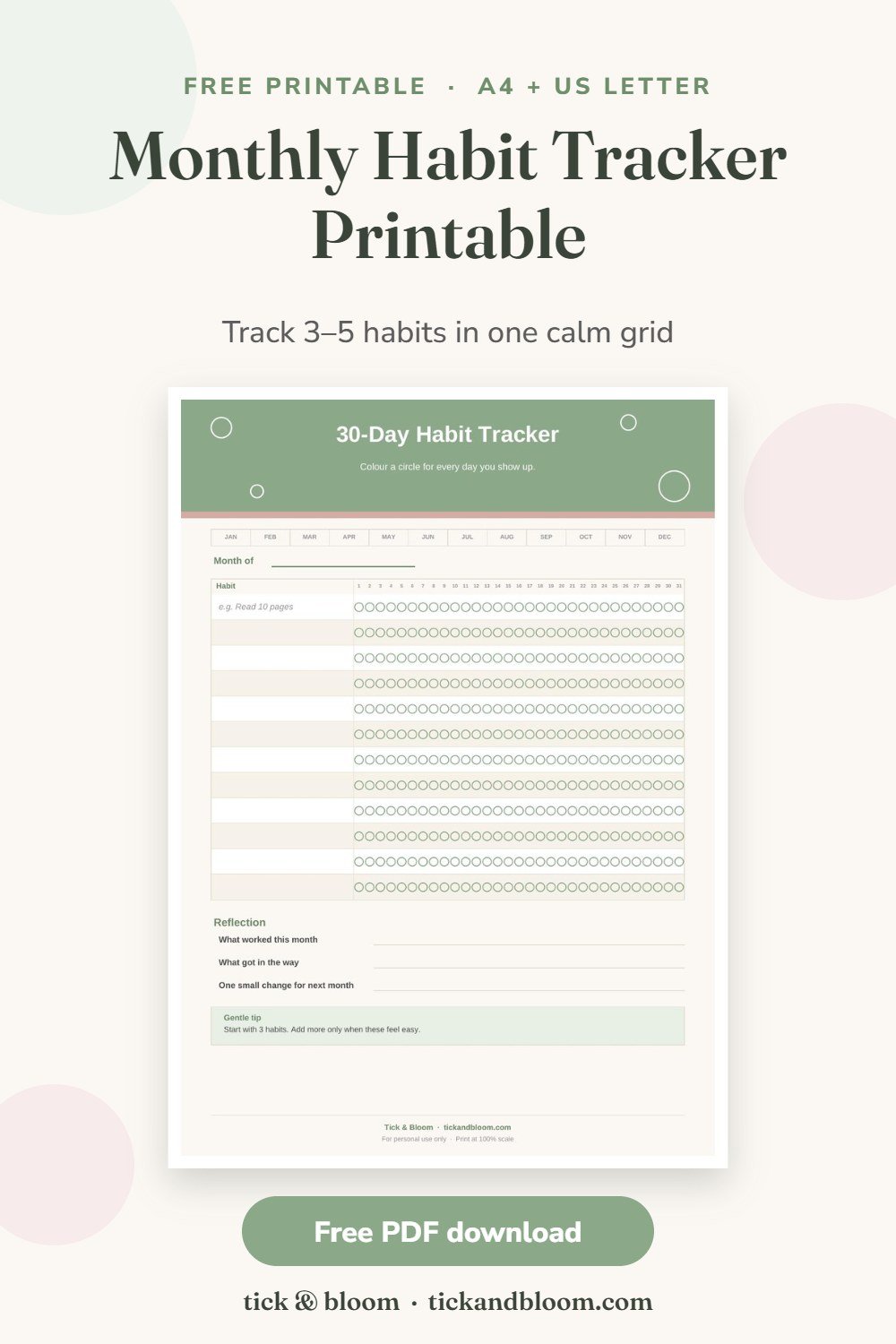
- The monthly grid itself — habits listed down the side, a box for each day of the month, and a reflection space at the bottom of the page.
- A Month in Circles page — a circle for every day, for watching just one habit closely.
- A completed sample page — a tracker already filled in, showing how ticks, notes and the reflection space work in practice before you begin your own.
- A low-ink version — the same tracker printed lighter, so it uses less ink at home.
- A weekly water tracker — a short strip for keeping up with daily water, the habit most people start with.
It comes in A4 and US Letter, and it is undated, so one download serves every month of the year. Download your size here:
How to set up your monthly grid
Setting up this monthly habit tracker printable takes about ten minutes:
1. Choose three to five habits, no more. A monthly page makes it tempting to track everything at once, but a grid with twelve rows usually dies by the second week. Three to five habits is enough to see a pattern and few enough to keep on a tired day.
2. Write the smallest honest version of each habit. “Read” is vague; “Read two pages” is a box you can tick. “Go for a walk” becomes “Walk for ten minutes”. The smallest version is the one you can still do on your worst day of the month, and it is the version that keeps the grid alive.
3. Match the grid to the real month. February has 28 days, April has 30, January has 31. Cross out the boxes that do not exist before you start, so an empty box never looks like a missed day. If you are starting mid-month, cross out the days that have already passed — a tracker that begins today is not “late”, it is simply honest.
4. Give non-daily habits a target, not a daily box. Some habits are three-times-a-week habits. For those rows, write the weekly target beside the habit name (for example, “×3 per week”) and lightly shade the days that were never planned. At the end of the month you are comparing ticks with the target you actually set, not with a perfect row of 31.
5. Put the page where the habits happen. Kitchen habits belong on the fridge; desk habits belong beside the keyboard. A tracker filed in a drawer is a tracker that gets filled in from memory on Sunday night, and memory is generous in ways that help nobody.
Filling it in without turning it into homework
Tick the box on the same day, ideally straight after the habit. Use one simple mark — a tick, a filled circle, a coloured box — and keep it the same all month so the page stays easy to read. If you prefer, add a tiny note in the reflection box when a day goes unusually well or badly; one line is plenty.
Expect gaps. A missed day is information, not a verdict, and the kindest working rule is simply to avoid missing twice in a row. If you are setting up tracking for your children as well, the same gentle approach works there too — our habit tracker for kids guide shows how to run it without turning it into a battle over rewards, and the matching morning routine checklist for kids covers school mornings specifically.
Rewards that keep you going
A monthly grid works because the ticks themselves are satisfying, but a small, planned reward at a milestone makes the middle of the month easier — the part where most grids quietly die. The rule is simple: the reward should celebrate the effort, not undo the habit.
1. Reward the streak, not perfection. Decide the milestone before the month starts — for example, seven ticks in a row, or three weeks with no more than one missed day. A missed day does not cancel the reward; the “never miss twice” rule from above still applies, so one gap is information, not failure.
2. Keep it small and immediate. The best rewards cost little and arrive the same day the milestone is hit: a favourite coffee, an evening with no chores, a new pen for the tracker itself, or an hour with a book you have been saving. Big, delayed rewards (“a holiday if I finish the month”) rarely survive week three; small, same-day ones do.
3. Match the reward to the habit, never against it. If the habit is walking, the reward is not a day on the sofa — it is a walk somewhere nicer than usual. If the habit is reading, it is a chapter of something purely for pleasure. A reward that pulls in the opposite direction teaches the brain that the habit is the chore to escape from.
4. Make the reward visible on the page. Write the milestone and its reward at the top of the grid before day one, in the same pen as the habits. When the page is on the fridge or beside the keyboard, the reward is part of the system, not a vague promise made in week one and forgotten by week two.
5. Let a shared grid share the reward. If two people track on one monthly page — the couples’ version of this grid is covered in our habit tracker for couples guide — agree the milestone reward together. A shared coffee, a film night, or a walk you both enjoy turns one person’s streak into something the household notices.
One caution: if a reward stops working, change the reward, not the habit. A grid that only survives on one particular treat was never really about the treat — shrink the habit to its smallest honest version, as in the setup section above, and pick a smaller reward to match.
The 10-minute end-of-month review
This is the part most tracker pages leave out, and it is the part that makes next month better. On the last evening of the month, sit down with the finished page and a pen:
- Count (2 minutes). Total the ticks in each row. No commentary yet, just the numbers.
- Compare with the target (2 minutes). Daily habits are judged against the days that existed; three-times-a-week habits against their weekly target, not against 31.
- Spot one pattern (3 minutes). Look for where the gaps gathered — weekends, one weekday, the busy week of the 20th? One honest pattern, not a list of faults.
- Decide keep, shrink or drop (2 minutes). Keep what flowed. Shrink anything that only happened on your best days — the smallest version was still too big. Drop, without guilt, anything you plainly do not want; a tracker full of other people’s goals helps no one.
- Carry one lesson forward (1 minute). Write a single sentence at the top of next month’s page: “Evenings work better than mornings”, or “Two habits is my real limit right now”. One lesson per month compounds quietly across a year.
When the month goes off track
It will happen, usually around week three. Three things help. First, never back-fill more than a day or two from memory — a partly honest page is worth more than a tidy fiction. Second, restart where you are: cross out the lost days, keep the rows, and finish the month smaller rather than not at all. Third, a habit with a completely blank row two months running is the tracker doing its job: choose a different habit, or a smaller version.
Frequently asked questions
Can I start a monthly habit tracker in the middle of the month?
Yes. Cross out the days that have passed and begin today. A three-week page reviewed honestly teaches you more than waiting for a perfect first of the month.
How many habits should a beginner track?
Start with three. You can add a fourth or fifth next month if the grid still feels light. Adding is easy; recovering from an abandoned page is not.
Is a monthly tracker the same as a 30-day habit tracker?
They are close cousins. A 30-day tracker is a set challenge that can start on any date; a monthly tracker follows the calendar month, which makes the end-of-month review and month-to-month comparisons simpler.
Which paper size should I print?
A4 if you are in the UK, Europe or most of the world; US Letter if you are in the United States or Canada. Both sizes are in the free download above, and every other pack on our free printables page follows the same two-size rule.
Start your month
Print the grid, choose three habits, write them at their smallest honest size, and put the page where you will see it tomorrow morning. The first month does not need to be impressive — it needs to be finished, reviewed, and followed by a slightly wiser second month. That is the whole system.