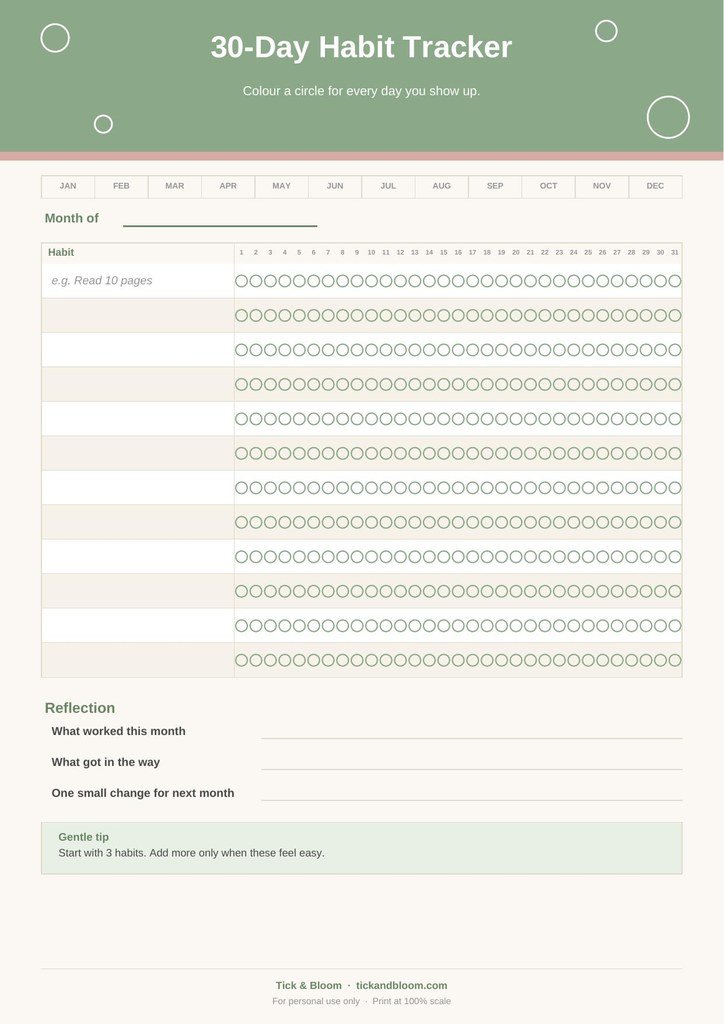
A habit tracker for couples works best as one shared monthly grid, not two separate trackers. Print one page, put both sets of initials on it, and review it together once a week — that shared page is what turns good intentions into a routine you both actually keep.
Most couples do not fail at habits because they lack willpower. They fail because each person tracks alone, in a different app or notebook, and nobody ever looks at the two trackers side by side. A shared grid fixes that in the simplest possible way: the habits are visible, the progress is visible, and the conversation about them happens once, at a set time, instead of as a running commentary all week.
The one-grid method
Take one monthly grid — the free Habit Tracker v2 pack linked below — and use it for both of you. Write the shared habits down the left-hand side, one habit per row. Across the top, write the days of the month. Then split each day’s box in two: one half for each person’s initials, or one colour pen each.
That split box is the whole method. It keeps three kinds of habit on one page:
- Shared habits: things you do together, such as an evening walk or cooking at home. Either person can tick the box when it happens, because it counts for both of you.
- Parallel habits: things you each do on your own, such as reading before bed or a morning stretch. Each person ticks only their own half.
- Support habits: things one person does that make the other’s habit easier, such as laying out walking shoes the night before. These are easy to forget, and putting them on the grid is what makes the system feel like teamwork rather than surveillance.
Start with no more than five habits in total. A grid with five rows that gets filled in beats a grid with fifteen rows that gets abandoned by day six. You can always add a row next month; you cannot recover a month that felt like homework. For the basics of setting up a grid that lasts, read how to start a habit tracker you will actually keep before you print.
15 shared-habit ideas to choose from
Pick habits you both actually want, not habits one of you wants for the other. Talk through this list together and circle five. If a habit only appeals to one person, leave it off the shared grid — it belongs on a personal tracker, and our habit tracker for students shows how a solo grid works when only one person is tracking.
At home:
- Cook at home four evenings a week.
- A ten-minute tidy before bed.
- One screen-free evening a week.
- Eat one meal a day together, without phones at the table.
- Water the plants or tend one small household job together on Sundays.
Out and about:
- Walk together three times a week, even if it is only twenty minutes.
- One outing a month that is new to both of you — a market, a trail, a neighbourhood you have never explored.
- Cycle, swim or stretch together twice a week.
Money and planning:
- A weekly money check-in of ten minutes: what came in, what went out, what is coming up.
- Put a set amount aside each week towards a shared goal, and tick the box when the transfer is made.
- Plan next week’s meals together on Sunday.
Rest and connection:
- Read for twenty minutes before bed instead of scrolling.
- One phone-free hour in the evening.
- A weekly date, even a small one — a walk with coffee counts.
- Write down one good thing from the week, each, before the review.
Notice what is not on this list: no habit here requires the other person to change. Every idea is something you can both choose, both see and both tick. That is deliberate. A shared tracker that becomes a scorecard for one partner’s behaviour will not survive the month, and it should not.
The weekly review without nagging
The grid only works if the review is kind. Pick a fixed time — Sunday evening works for most couples — and keep it to ten minutes. Sit with the grid, not with a list of complaints, and follow the same three questions every week:
- What did we actually do? Count the ticks, not the gaps. A week with twelve ticks out of a possible twenty is a week that mostly worked.
- What got in the way? Name the obstacle, not the person. “The walk did not happen on rainy days” is a problem you can solve; “you never want to walk” is an argument.
- What do we change next week? Change one thing only: move the walk to mornings, shrink the tidy to five minutes, or drop a habit that neither of you enjoyed. A tracker that never changes becomes a record of failure; a tracker that adapts stays useful.
Two rules keep the review safe. First, nobody defends a missed day — a blank box is information, not an offence. Second, nobody adds a new habit during the review without the other person agreeing to it. The review adjusts the system; it never ambushes anyone with a new expectation.
If one person stops tracking for a week, do not restart with a lecture. Just put the grid back on the fridge, tick the days you did manage, and carry on. A missed week is not a failed month. Our monthly habit tracker guide explains the same end-of-month review ritual in more detail, and it works just as well for a shared grid: look at the pattern, keep what worked, and change one thing.
A filled example: one week on a shared grid
Imagine Maya and Jon, who chose five habits: an evening walk, cooking at home, a screen-free evening, a Sunday money check-in, and reading before bed. Their first week looks like this:
- Monday: walk together, cooked at home, both read. Three ticks.
- Tuesday: rain, so no walk; cooked at home; one read. Two ticks, and a note: “walk needs a wet-weather alternative.”
- Wednesday: screen-free evening, cooked at home. Two ticks.
- Thursday: walk together, both read. Two ticks.
- Friday: cooked at home, walk together. Two ticks.
- Saturday: walk together, both read. Two ticks.
- Sunday: money check-in done, walk together, cooked at home. Three ticks.
That is sixteen ticks out of a possible thirty-five if every habit happened every day — and it is still a good week, because the habits that mattered most happened most days, and the review found one fixable problem: the walk needs an indoor alternative for rainy days. That is what a shared tracker is for. It does not produce a perfect month. It produces one honest page that tells you what to adjust.
Families with children can run the same idea alongside a kids’ version: our habit tracker for kids guide uses the same monthly-grid logic at a child’s pace, so a family can review together without mixing adults’ and children’s habits on one page.
Get the free printable
The pack below gives you both one monthly grid — reflection box included — along with a Month in Circles page, a weekly water strip, a filled example and an ink-saver copy, in A4 and US Letter. Print one copy, pick your five habits together, and put it somewhere you both see it every day — the fridge door beats a drawer every time.
You can also browse the full free printables library for the other trackers mentioned in this article.
Frequently asked questions
Should couples track the same habits or different ones?
Both, on one page. Shared habits build the routine you do together; parallel habits keep the grid honest about what each person does alone. The rule is simple: if only one of you cares about a habit, it does not go on the shared grid.
What if one person stops filling it in?
Do not chase the missing ticks. Keep filling in your own half, keep the weekly review short, and let the grid sit where it is seen. Most people come back to a tracker that is waiting quietly; nobody comes back to one that has become a source of pressure.
How many habits should we start with?
Five at most, and three is fine for the first month. A small grid that gets used teaches you what works; a large grid that gets abandoned teaches you nothing except that large grids get abandoned.
Is a paper tracker better than an app for couples?
For a shared routine, paper has one advantage an app cannot copy: it sits in a shared space where both of you see it without opening anything. If an app already works for both of you, keep using it — the method matters more than the medium. But if you have tried apps and drifted away from them, a printed grid on the fridge is worth trying.