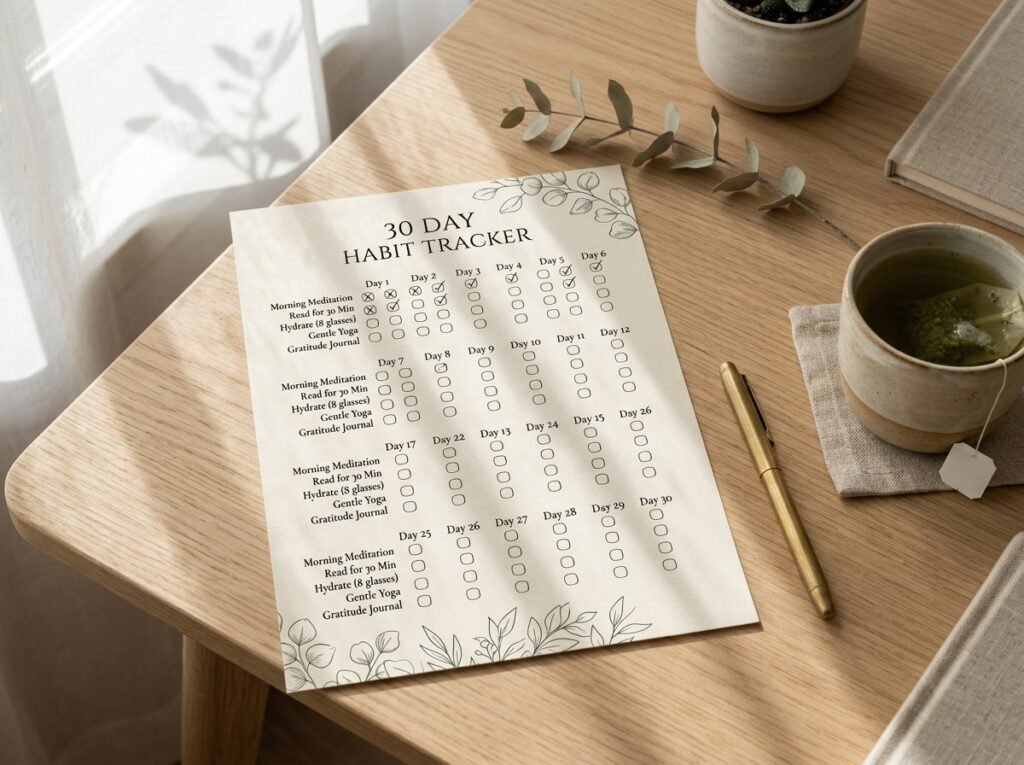
A habit tracker for ADHD printable works best when it is short, visible and forgiving: three habits at most, one row each, on a page you actually see every day — and a blank day breaks nothing. This free printable is a monthly grid built exactly that way, in A4 and US Letter, with a two-minute Sunday review instead of a streak to protect.
This is a paper tracking tool, not medical advice or a treatment plan. If you have a care team, follow their guidance. What follows is a way to lay out a month on paper so the habits you chose stay in sight — nothing more, and nothing it does not promise.
Why most trackers fall apart
Most habit trackers are designed for a person who remembers to open them. They fail in the same three ways, and each one is a design problem, not a willpower problem.
Too many rows. A tracker with ten habits asks for ten decisions a day. The first day feels ambitious; by day four the sheet is a list of things you did not do. A page full of empty boxes reads as failure, so it gets avoided, and then it gets abandoned.
Hidden from view. A tracker inside an app, a closed notebook or a drawer is a tracker you have to remember to check. The remembering is the hard part. A tracker that lives where the day already happens — beside the kettle, on the fridge, above the desk — gets seen without any effort at all.
Built on streaks. A streak tracker turns one missed day into a broken chain. Once the chain is broken, the tracker has nothing left to offer that week, so the week gets written off. The tracker was supposed to help; instead it punished the exact day it was needed most.
The tracker in this guide is built the other way round: three habits, one visible page, and a scoring rule that counts starts instead of streaks.
Rule 1: short — three habits, no more
Pick three habits. Not five, not a fresh start with twelve. Three rows on the grid, one habit per row, and the rest of the sheet stays empty on purpose.
Three is small enough to hold in your head and large enough to matter. One habit feels too thin to bother with; three feels like a system. And when a day goes badly, three boxes are a small thing to face the next morning. Ten boxes are a reason to stop looking.
Choose habits you can start in under two minutes. “Read for ten minutes” beats “read a chapter”. “Shoes by the door” beats “tidy the house”. “Glass of water with breakfast” beats “drink two litres”. The habit is the start, not the performance — the tracker counts that you began, and the size of the step is yours to set.
If you already track habits across the month, this is the same grid with a stricter rule. Our monthly habit tracker printable guide explains the full monthly rhythm; this guide is the version for brains that need the page shorter, louder and kinder.
Rule 2: visible — the page lives where the day happens
Print the grid and put it where you cannot miss it. The fridge door, the wall beside the kettle, the inside of the front door, the wall above the desk — anywhere your eyes land without being told to look there.
Colour in each box as soon as the habit is done, not at bedtime. A coloured box in the morning is a small visible win; a blank box at night is a reminder, not a verdict. Keep a pen tied to the page or clipped beside it — a tracker with no pen nearby is a tracker that waits until tomorrow, and tomorrow is where trackers go to die.
For a school morning, the same rule applies to a child: the page goes where the morning happens, not in a school bag. Our morning routine checklist for kids printable covers the same ground for the first hour of the day, and this grid is what watches the pattern across the month.
Rule 3: forgiving — count starts, not finishes
This is the rule that makes the tracker survive a bad week. A half-start counts. A box coloured in for “started” counts exactly the same as a box coloured in for “finished perfectly”. A blank day breaks nothing — the next day is a fresh box, not a debt.
A streak asks “did you do it every day?” and the honest answer is usually no. A pattern asks “how often did you start?” and the answer is almost always better than you feared. Starts are the thing that matters: a habit you start eleven times in a month is a habit that exists. A habit you started twice and then abandoned because the streak broke is a habit that does not.
Research on habit formation (Lally et al., 2010) found a single missed day had little impact on later progress. The tracker is built on that finding: one missed day is a blank box, not a broken system. Two missed days in a row is worth noticing, not worth quitting over — and the Sunday review below is where you notice it.
Setting up the grid
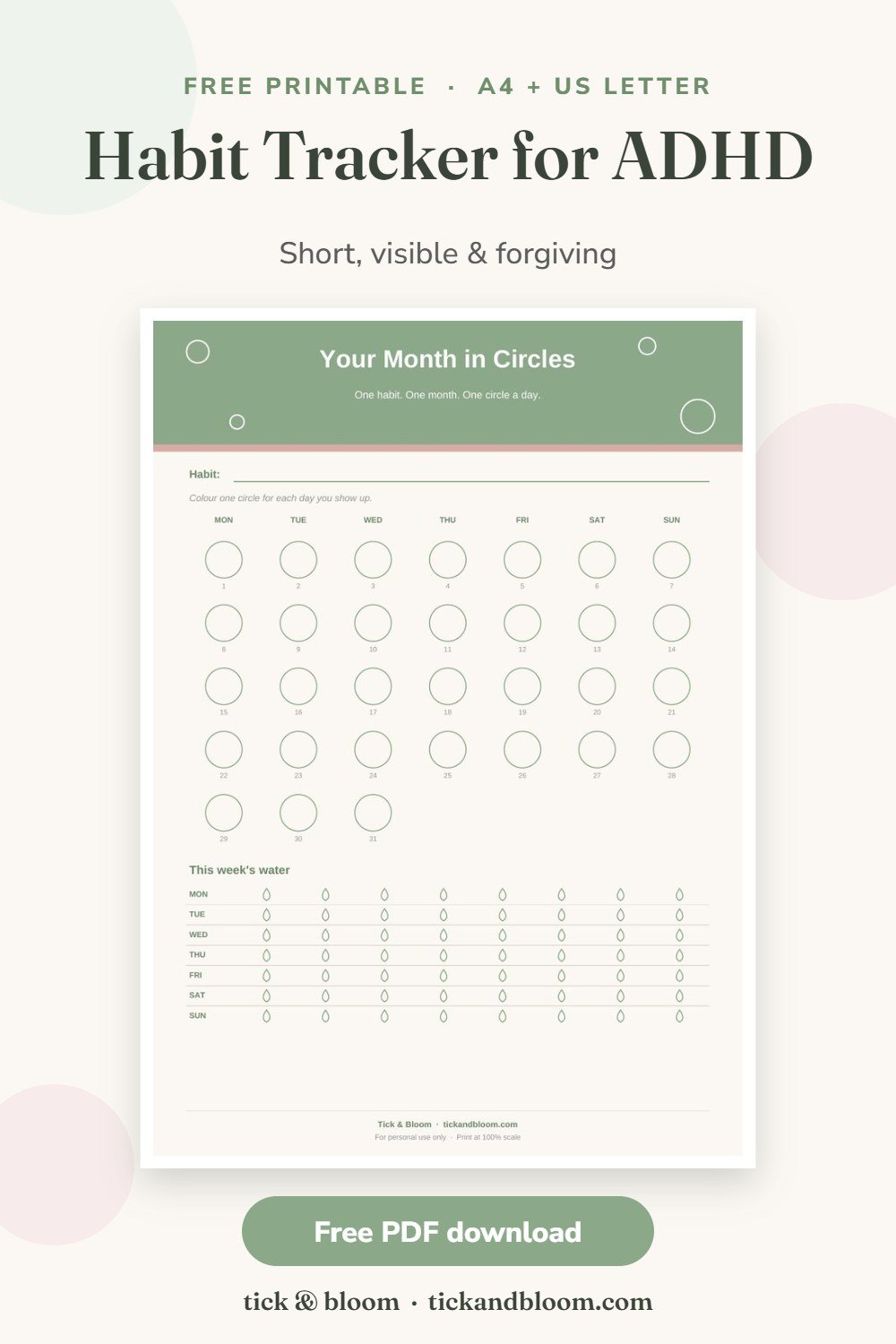
The free pack is the monthly grid from our Habit Tracker v2 set: a 30-day grid with a space to reflect at the end, a circles page for following one habit day by day, a water-tracking strip for the week, a completed sample, and a printer-friendly light version. For this guide, use the grid page only, and use it like this:
- Write your three habits in the three rows. One habit per row. Leave the rest of the grid blank — blank rows are not wasted space, they are the rule working.
- Write the dates across the top. One column per day, for the month you are in.
- Colour a box when you start the habit. Any colour, any mark — a tick, a dot, a scribble. The mark means “I started”, and that is the whole scoring system.
- Keep the pen with the page. If the pen walks away, the boxes stay empty, and empty boxes lie about a month that actually went fine.
If three habits start feeling easy after a couple of weeks, do not add a fourth mid-month. Finish the month with three, then choose a fresh three for the next month — or keep the same three and let them get steadier. Changing the rules mid-month is how a forgiving tracker turns into a strict one.
A filled example: one adult day, one school morning
A filled example is worth more than a set of instructions, so here is what two finished rows look like on an ordinary day.
An adult’s three rows. Row one: “Water with breakfast”. Row two: “Ten minutes of reading before bed”. Row three: “Shoes by the door after coming home”. On a good day, all three boxes are coloured by bedtime. On a rushed day, only the water box is coloured — the glass was poured, the book stayed shut, the shoes stayed by the stairs. That day still counts as one start out of three, and the month still shows a pattern of mornings that begin with water, which is a real thing to learn about your own day.
A child’s school-morning rows. Row one: “Breakfast finished before shoes on”. Row two: “School bag by the door the night before”. Row three: “Teeth brushed before leaving”. The same scoring applies: a half-start counts, a blank day breaks nothing. If mornings are the hard part, our habit tracker for kids guide covers the same grid from a parent’s side, with the same three-row rule.
Notice what neither example does: it never asks for a perfect day. The grid records what happened. That is its job.
The two-minute Sunday review
Once a week, on Sunday, spend two minutes with the page. Not a journal entry, not a planning session — two minutes, three questions:
- Which row filled up most? That habit has found its place in the day. Keep it exactly as it is.
- Which row stayed blank most? That habit may be too big, too vague, or in the wrong part of the day. Shrink it, move it, or swap it for a smaller version next month — do not just try harder at the same shape.
- What got in the way? Look for a pattern, not a person to blame. If the reading box is empty on every late-work day, the problem is the late work, not the reader. Move the reading to the morning, or make it five minutes instead of ten.
That is the whole review. The point is patterns, not perfection: the grid shows you which habits fit your real days and which ones only fit imaginary ones. Our pillar guide on how to start a habit tracker you will actually keep explains the same monthly review in full, for the months when three rows grow into a wider system.
When a week falls apart
It will, usually in the second week. A busy stretch, a bad night, a change of routine — and suddenly four blank days sit in a row. Three things help.
First, do not backfill. Colouring in boxes from memory makes the grid a work of fiction, and a fictional grid cannot show you anything true. Leave the blanks blank. They are information, not a confession.
Second, restart with one row, not three. Pick the easiest habit, colour its box tomorrow, and let the other two wait a day. A tracker that restarts small is a tracker that restarts at all.
Third, remember the finding: research on habit formation (Lally et al., 2010) found a single missed day had little impact on later progress. A missed week is not a single missed day, but the principle holds — the grid does not keep score against you. It keeps a record for you, and the record is still useful the day you pick the pen up again.
If you are a student using this grid around classes, the same restart rule applies: one row, tomorrow, no backfilling. Our habit tracker for students guide shows how the monthly grid runs alongside a timetable, and the daily planner takes over inside a single day.
What is inside the free pack
This article uses our Habit Tracker v2 — 30-Day Pack, the same monthly grid behind the monthly tracker guide:
- The 30-day grid — one row per habit, with a space to reflect at the end of the month.
- A circles page — for following one habit day by day, if a single habit deserves its own page.
- A water-tracking strip — for the week, if water is one of your three.
- A completed sample — so you can see exactly how a filled month looks before you start your own.
- A printer-friendly light version — kinder to home printers.
It comes in A4 and US Letter, and it is undated, so one download serves every month of the year. For this guide, use three rows and leave the rest blank — that is the whole method. Download your size here:
Frequently asked questions
Is this tracker a medical tool?
No. It is a paper page for recording whether you started three small habits. It is not medical advice or a treatment plan, and it does not claim to help with any condition. If you have a care team, follow their guidance — this grid is a way to see your own days clearly, nothing more.
How is this different from the monthly habit tracker?
It is the same monthly grid, used with a stricter rule: three rows only, starts count instead of streaks, and a two-minute Sunday review. The monthly habit tracker printable guide is the general version for any number of habits; this guide is the short, visible, forgiving version for days when remembering is the hard part.
What if I miss a whole week?
Leave the blanks blank and restart with one row tomorrow. Do not backfill from memory, and do not throw the month away — the blank week is part of the record, and the Sunday review will show you what got in the way. The same forgiving logic applies throughout: one missed day changes little, and a missed week is still just a record of what happened, not a verdict on the month.
Can children use this tracker?
Yes — the three-row rule works the same way for a school morning: breakfast, bag by the door, teeth brushed. Keep the page where the morning happens, colour the box as soon as the habit starts, and let a blank day break nothing. The habit tracker for kids guide covers the same grid from a parent’s side.
Which paper size should I print?
A4 if you are in the UK, Europe or most of the world; US Letter if you are in the United States or Canada. Both sizes are in the free download above, and every other pack on our free printables page follows the same two-size rule.
Start tomorrow
Print the grid, write three habits in three rows, and put the page where the day happens. Colour one box tomorrow for the easiest habit — just the start, nothing more. On Sunday, spend two minutes asking which row filled up and which one stayed blank. That is the whole system: short, visible, forgiving. The first month does not need to be impressive. It needs to be honest, looked at once a week, and followed by a slightly wiser second month.